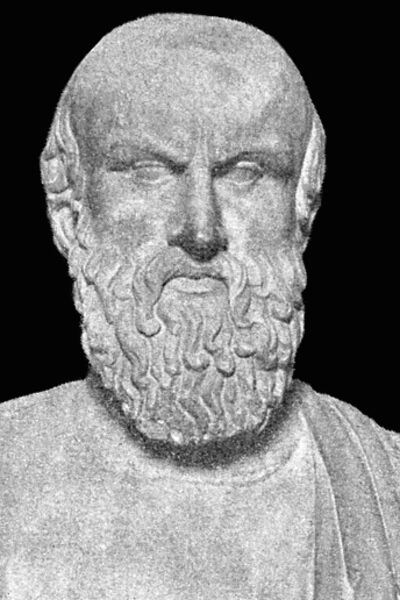
Aeschylus
Aeschylus
The father of tragedy
c. 525 BC – 456 BC
Aeschylus was born around 525 BC at Eleusis, near Athens, into a noble family. He fought at Marathon in 490 BC — a fact he considered more important than anything he ever wrote, as his self-composed epitaph attests. He fought again at Salamis in 480 BC. These experiences of war against overwhelming odds shaped his dramatic imagination permanently.
He is said to have written between seventy and ninety plays, of which seven survive. He won his first victory at the Great Dionysia around 484 BC and dominated the Athenian stage for a generation. His great innovation was the introduction of a second actor, which transformed tragedy from a dialogue between a single performer and the chorus into genuine drama. Before Aeschylus, tragedy was lyric poetry with costumes. After him, it was theatre.
The Oresteia — Agamemnon, Choephori, Eumenides — is the only complete trilogy to survive from ancient Athens. It traces the curse on the house of Atreus from the murder of Agamemnon through Orestes' revenge to his trial and acquittal in Athens, transforming a blood feud into the foundation of civic justice. The Persians dramatises the Battle of Salamis from the Persian perspective — astonishingly, only eight years after the event, and for an audience of veterans. Prometheus Bound, Seven Against Thebes, and The Suppliants complete the surviving canon.
Aeschylus died in Sicily around 456 BC. The legend that he was killed by a tortoise dropped on his bald head by an eagle is probably too good to be true.
Works (7)
- 1
- 2
-
3
Libation Bearers prose
Orestes returns to Argos to avenge his father by killing his mother. Electra recognises him at Agamemnon's tomb. The murder is deliberate, commanded b...
- 4
-
5
Prometheus Bound prose
Prometheus stole fire from the gods and gave it to humanity. Zeus had him chained to a rock in the Caucasus. He does not repent. The oldest drama abou...
-
6
Seven Against Thebes oratory
Two brothers fight over who will rule Thebes. Both sides know the prophecy: they will kill each other. The curse of Oedipus falls on the next generati...
- 7
Lost & Fragmentary Works
-
Lost PlaysTragedy
Aeschylus wrote between 70 and 90 plays, of which only 7 survive complete. The lost plays include the remaining parts of several trilogies and many independent tragedies and satyr plays.
Originally: ~80 plays. Surviving: 7 complete plays; fragments and titles of the rest.
Radt, Tragicorum Graecorum Fragmenta, vol. III (Göttingen, 1985)