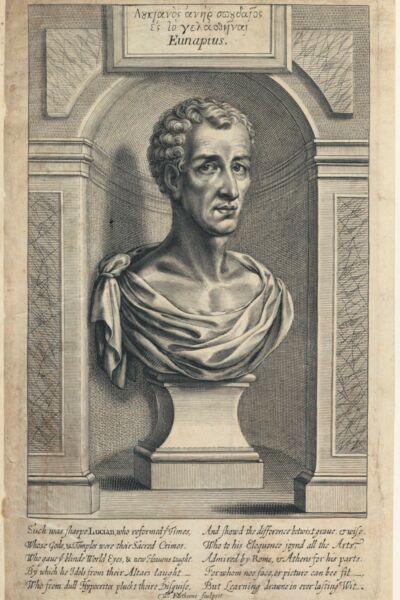
Lucianus Samosatensis
Lucian of Samosata
Antiquity's greatest satirist
c. 125 AD – c. 180 AD
Lucian was born around 125 AD in Samosata on the Euphrates, in the Roman province of Syria. His native language was probably Aramaic; he learned Greek as a second language and mastered it so completely that he became one of the wittiest prose stylists in the history of the language. He trained as a rhetorician, toured the eastern Mediterranean giving lectures, and eventually settled in Athens, where he produced the bulk of his surviving work.
About eighty works survive — dialogues, essays, satires, and prose narratives. The range is extraordinary. Dialogues of the Dead brings historical and mythological figures together in Hades for mordant conversations. True Histories is a fantastical voyage narrative — the first science fiction, in a sense — that parodies travel literature with gleeful inventiveness. The Passing of Peregrinus is a savage attack on a Christian-turned-Cynic charlatan. Alexander the False Prophet exposes a fraudulent oracle. Timon is a dialogue on wealth and poverty that Shakespeare later drew on for Timon of Athens.
Lucian's characteristic mode is ironic detachment. He believes in nothing much — not the gods, not philosophy, not rhetoric, not medicine — and subjects everything to his sceptical, amused intelligence. He is the great debunker of antiquity, and one of its most entertaining writers.
Works (71)
- 1
-
2
Adversus indoctum et libros multos ementem satire
Against the book-collector who buys thousands of volumes and reads none of them. Lucian's attack on intellectual pretension through consumer habits.
- 3
-
4
Anacharsis satire
A Scythian philosopher visits Greece. Anacharsis and Solon discuss athletics, education, and what makes a society strong.
- 5
- 6
-
7
Bis accusatus sive tribunalia satire
Zeus puts Lucian on trial for undermining religion, while Rhetoric accuses him of deserting oratory for philosophy. Lucian defends himself against bot...
-
8
Calumniae non temere credundum satire
That slander should not be believed rashly. A moral essay on the damage caused by malicious gossip, with a famous description of Apelles' painting of...
- 9
-
10
Contemplantes satire
Observers. Two characters survey the world from a great height, watching human folly with amused detachment.
-
11
Dearum judicium satire
The judgment of the three goddesses. Paris must award the apple to Hera, Athena, or Aphrodite. Each offers a bribe. He chooses beauty. Troy falls.
-
12
De astrologia satire
On astrology. A brief defence of astrology, probably not by Lucian. It argues that the stars influence human affairs.
- 13
- 14
-
15
De mercede satire
On salaried positions in great houses. Lucian describes the miserable life of Greek intellectuals employed by wealthy Roman patrons — the indignity of...
- 16
-
17
De Morte Peregrini satire
The death of the Cynic Peregrinus, who immolated himself at Olympia. Lucian treats the event as grotesque self-promotion — a charlatan's final perform...
-
18
Deorum concilium satire
An assembly of the gods debates who deserves membership on Olympus. Many foreign deities are exposed as fraudulent immigrants. Lucian satirises both r...
-
19
De parasito sive artem esse parasiticam satire
A treatise arguing that being a parasite is a genuine skill. Satirical throughout — the parasite's "art" is defended with the same arguments philosoph...
-
20
De Sacrificiis satire
On sacrifices. Lucian ridicules traditional religious practices — blood sacrifice, libations, and animal offerings — as absurd attempts to bribe the g...
-
21
De saltatione satire
On dancing. A defence of pantomime as an art form, arguing that the dancer must master mythology, music, and physical expression. Lucian's most sustai...
-
22
De Syria dea satire
On the Syrian goddess. A description of the temple and cult at Hierapolis in Syria, written in pseudo-Herodotean Ionic. Whether Lucian is serious or p...
-
23
Dialogi deorum satire
Dialogues of the gods. Zeus, Hera, Hermes, and the others behave like petty humans — jealous, vain, and absurd. Lucian strips the Olympians of their d...
-
24
Dialogi Marini satire
Dialogues of the sea gods. Poseidon, the Nereids, and Polyphemus discuss love, storms, and metamorphosis. Lighter than the Dialogues of the Dead.
-
25
Dialogi meretricii satire
Dialogues of the courtesans. Fifteen conversations between hetairai about love, jealousy, and the economics of their profession. Lucian's most sympath...
-
26
Dialogi mortuorum satire
Thirty short dialogues of the dead. Menippus mocks the famous in the underworld — heroes, philosophers, and kings all reduced to skulls. The ultimate...
- 27
- 28
- 29
- 30
- 31
-
32
Harmonides satire
Harmonides asks his teacher whether technical skill alone will make him famous. The answer: you need an audience, not just ability.
- 33
-
34
Hermotimus satire
A philosophical dialogue in which Hermotimus, after twenty years of Stoic study, is persuaded that he has wasted his life. Lucian's most serious attac...
- 35
- 36
- 37
-
38
Icaromenippus satire
Menippus flies to heaven on wings made from a vulture and an eagle to ask Zeus why the philosophers disagree about everything. The answer is not reass...
- 39
-
40
Judicium vocalium satire
The consonants at law. The letter Sigma takes Tau to court for encroaching on words that rightfully begin with S. A grammatical joke presented as a le...
-
41
Juppiter Confutatus satire
A Cynic philosopher cross-examines Zeus about fate, free will, and divine justice. Zeus loses the argument.
-
42
Juppiter Tragoedus satire
Zeus on the tragic stage. The gods debate what to do about the Epicurean philosophers who deny divine providence. Zeus is not confident in his own cas...
-
43
Lexiphanes satire
Lexiphanes uses comically archaic vocabulary in a pastiche of Plato's Symposium. Lucian makes him drink an emetic to purge the affected words from his...
- 44
-
45
Muscae Encomium satire
A praise of the fly. Lucian demonstrates his rhetorical skill by delivering a formal encomium of the most trivial subject he can think of.
- 46
-
47
Necyomantia satire
Menippus consults a necromancer to visit the underworld and discover the best way to live. The dead agree: enjoy simple pleasures and stop worrying ab...
- 48
-
49
Patriae encomium satire
A praise of one's homeland. Lucian argues that love of country is natural and honourable — one of his few straightforwardly earnest essays.
- 50
-
51
Philopseudes sive incredulus satire
The Liar, or The Doubter. A collection of supernatural stories — ghosts, haunted houses, animated statues — told at a dinner party. The sceptic narrat...
- 52
- 53
-
54
Pro imaginibus oratory
A defence of Portraits, responding to criticism that the praise was excessive.
-
55
Pro lapsu inter salutandum oratory
An apology for the slip "health to you" made while greeting a patron. Lucian turns a social embarrassment into a learned essay on linguistic conventio...
-
56
Prometheus satire
Prometheus defends himself before Zeus for giving fire to humanity. The trial is both a mythological sketch and a meditation on the cost of progress.
-
57
Prometheus es in verbis oratory
Lucian defends his own writing style as Promethean — he claims to have invented a new genre by combining dialogue and comedy.
-
58
Pseudologista satire
A mock-legal attack on a rival sophist for barbarisms and solecisms. Lucian's most personal and vicious polemic.
-
59
Quomodo historia conscribenda sit satire
How to write history. Lucian attacks the incompetent historians of the Parthian war and sets out principles for honest historical writing — no flatter...
-
60
Rhetorum praeceptor satire
A teacher of rhetoric explains how to succeed: skip the hard work, memorise a few impressive words, gesticulate wildly, and insult anyone who criticis...
-
61
Saturnalia satire
A satirical sketch of the Saturnalia. Cronus answers complaints from the poor about the unfairness of wealth distribution during the festival.
- 62
- 63
-
64
Somnium sive vita Luciani satire
A dream of Lucian's youth in which Sculpture and Education fight over his future career. He chooses Education. A Lucianic origin story.
-
65
Symposium philosophy
A dinner party goes wrong. Philosophers, poets, and rhetoricians get drunk and fight. Lucian's version of the symposium tradition — where the guests b...
- 66
-
67
Toxaris vel amicitia satire
Toxaris and Mnesippus trade stories of extraordinary friendship — Greeks and Scythians competing to prove that their culture produces better friends.
-
68
Tyrannicida satire
The tyrannicide. A man kills a tyrant's son; the tyrant kills himself in grief. Does the man deserve the reward for tyrannicide? A legal declamation.
-
69
Verae historiae history
Lucian's masterpiece. Two books of fantastical voyages — to the Moon, inside a whale, to the Island of the Blessed. He warns the reader at the start:...
-
70
Vitarum auctio satire
Philosophers up for auction. Zeus sells off the great philosophers — Pythagoras, Diogenes, Socrates, Aristotle — to the highest bidder, each reduced t...
- 71