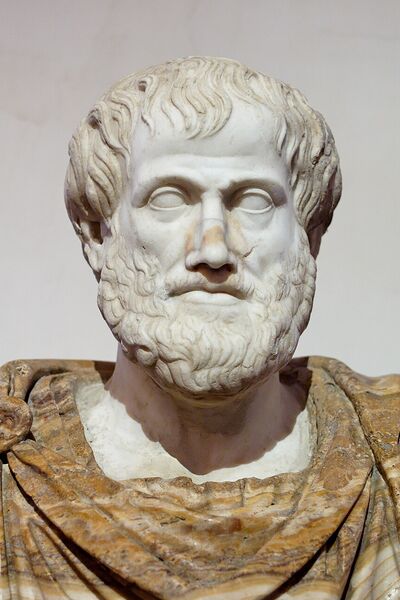
Aristoteles
Aristotle
384 BC – 322 BC
Aristotle was born in 384 BC in Stagira, a small city in Chalcidice, to Nicomachus, personal physician to King Amyntas III of Macedon. At seventeen he entered Plato's Academy in Athens, where he remained for twenty years until Plato's death in 347 BC. He then spent years travelling — in Assos, Lesbos (where he conducted his pioneering biological research), and at the Macedonian court, where he tutored the young Alexander.
In 335 BC he returned to Athens and founded his own school, the Lyceum, in a grove sacred to Apollo Lyceus. For twelve years he lectured, researched, and wrote — or rather, his students compiled notes from his lectures, which is largely what survives. When Alexander died in 323 BC, anti-Macedonian feeling made Athens dangerous for Aristotle. He withdrew to Chalcis, reportedly saying he would not allow Athens to sin twice against philosophy. He died there in 322 BC.
The surviving works — the Nicomachean Ethics, Politics, Poetics, Metaphysics, Rhetoric, and many others — are not polished publications but working texts, dense and sometimes obscure. They nevertheless represent the most ambitious intellectual achievement of the ancient world. Aristotle essentially created formal logic, zoology, literary criticism, and political science as disciplines, and made foundational contributions to physics, metaphysics, ethics, and psychology. No single thinker has shaped Western intellectual history more profoundly.
Works (49)
-
1
Analytica priora prose
Aristotle's foundational treatise on formal logic. The Prior Analytics develops the theory of the syllogism — the first systematic account of deductiv...
-
2
Categoriae prose
The first work of Aristotle's logical Organon. The Categories classifies everything that can be said about anything into ten fundamental types — subst...
-
3
Constitution of the Athenians philosophy
A survey of 158 Greek constitutions, of which only the Athenian survives. Rediscovered on a papyrus in Egypt in 1890, it is the most detailed ancient...
-
4
De anima philosophy
Aristotle's investigation into the nature of the soul — not as a religious concept but as the principle of life itself. De Anima asks what makes livin...
-
5
De anima (codicis E fragmenta recensionis a vulgata diversae) philosophy
Fragments from Codex E preserving an alternative recension of Aristotle's De Anima, diverging from the standard text tradition. A witness to the compl...
-
6
De animalium incessu philosophy
A compact inquiry into how animals walk, fly, and swim. Aristotle asks why snakes have no legs, why birds have two, and why no animal moves on an odd...
-
7
De animalium motione philosophy
A short treatise on what causes animals to move at all. Aristotle argues that movement requires both a desired object and a bodily mechanism capable o...
-
8
De audibilibus prose
A short treatise from the Aristotelian corpus examining how sounds are produced and perceived. It analyses echoes, resonance, and the physical propert...
- 9
-
10
De coloribus prose
A short treatise from the Aristotelian corpus investigating the nature and causes of colour. It examines how colours arise from mixtures of light and...
-
11
De divinatione per somnum prose
A brief investigation into whether dreams can predict the future. Aristotle is characteristically sceptical — he argues that most prophetic dreams are...
-
12
De Generatione Animalium prose
Aristotle's comprehensive account of animal reproduction. Across five books, he examines how every kind of animal generates offspring — from the matin...
-
13
De generatione et corruptione prose
An investigation into coming-to-be and passing-away. Aristotle distinguishes generation and destruction from mere alteration, and asks what it means f...
-
14
De insomniis prose
A brief treatise on the nature of dreams. Aristotle argues that dreams are not sent by the gods but are afterimages of waking sense-perceptions, linge...
-
15
De interpretatione prose
Aristotle's treatise on the relationship between language and thought. De Interpretatione examines propositions, their truth and falsehood, and the lo...
-
16
De iuventute et senectute, De vita et morte prose
Two connected short treatises examining youth and old age, and life and death. Aristotle investigates the biological mechanisms that sustain life and...
-
17
De lineis insecabilibus prose
A treatise from the Aristotelian corpus arguing against the atomist theory that lines are composed of indivisible units. The work defends the infinite...
-
18
De longitudine et brevitate vitae prose
A brief inquiry into why some animals live longer than others. Aristotle connects longevity to the body's moisture and heat, arguing that larger, mois...
-
19
De memoria et reminiscentia prose
A short treatise on how memory works and how we recall things we have forgotten. Aristotle distinguishes memory (a passive retention of past experienc...
-
20
De partibus animalium prose
Aristotle's masterwork of comparative anatomy. Across four books, he examines the parts of animals — bones, organs, blood, and tissues — explaining th...
-
21
De plantis prose
A treatise on botany attributed to Aristotle but likely by his student Nicolaus of Damascus. It examines plant generation, growth, and the differences...
-
22
De respiratione prose
A short treatise on the mechanics of breathing. Aristotle connects respiration to the body's need to regulate its internal heat, arguing that cooling...
-
23
De sensu et sensibilibus prose
A systematic investigation of sense-perception. Aristotle examines each of the five senses in turn — sight, hearing, smell, taste, and touch — asking...
-
24
De somno et vigilia prose
A compact treatise on the nature and purpose of sleep. Aristotle argues that sleep is a natural consequence of perception — the sense organs need peri...
-
25
De sophisticis elenchis philosophy
Aristotle's treatise on fallacious reasoning. The Sophistical Refutations catalogues thirteen types of logical fallacy and teaches how to detect and d...
-
26
De spiritu prose
A short treatise from the Aristotelian corpus examining the nature of pneuma — the breath or vital spirit that connects the soul to the body. It inves...
-
27
De ventorum situ et nominibus prose
A brief geographical treatise from the Aristotelian corpus cataloguing the winds by their positions and names, mapping them to the points of the compa...
-
28
De Xenophane, de Zenone, de Gorgia prose
Three connected essays from the Aristotelian corpus examining the philosophical positions of Xenophanes, Zeno of Elea, and Gorgias. Each thinker's arg...
-
29
Divisiones Aristoteleae prose
A collection of logical divisions and classifications attributed to Aristotle. The work organises concepts into systematic taxonomies — dividing goods...
-
30
Economics philosophy
A treatise on household management and the acquisition of wealth, partly attributed to Aristotle. Book I discusses whether moneymaking is natural; Boo...
- 31
-
32
Eudemian Ethics philosophy
A parallel treatment of ethics to the Nicomachean, possibly compiled from Aristotle's earlier lectures. The relationship between the two treatises rem...
-
33
Historia animalium prose
The largest surviving work of ancient biology. Across ten books, Aristotle catalogues the anatomy, behaviour, diet, and reproduction of hundreds of an...
-
34
Magna Moralia prose
A treatise on ethics attributed to Aristotle, possibly a student's notes from his lectures. The Magna Moralia covers much of the same ground as the Ni...
- 35
-
36
Metaphysics philosophy
Aristotle investigates the nature of being, substance, causation, and the divine. Fourteen books that range from logic to theology. The title means si...
-
37
Meteorologica prose
Aristotle's investigation of atmospheric and geological phenomena. The Meteorologica examines rain, wind, thunder, earthquakes, comets, and the rainbo...
-
38
Mirabilium auscultationes prose
A collection of remarkable natural phenomena from across the known world, compiled from the Aristotelian school. Each entry reports something extraord...
-
39
Nicomachean Ethics philosophy
What is the good life? Not wealth, not pleasure, not honour — but eudaimonia: a life of excellent activity in accordance with virtue. Aristotle's Nico...
-
40
On Virtues and Vices philosophy
A short treatise cataloguing virtues and their opposing vices. Almost certainly not by Aristotle, but included in the ancient corpus.
- 41
-
42
Physica (textus alter) prose
An alternative text of Aristotle's Physics, preserving variant readings from a different manuscript tradition.
-
43
Physiognomonica prose
A treatise from the Aristotelian corpus on reading character from bodily features. The Physiognomonica correlates physical traits — forehead shape, ey...
-
44
Poetics philosophy
What is tragedy? What makes a good plot? Aristotle analyses the structure of dramatic poetry with surgical precision. The concepts he introduces — cat...
-
45
Politics philosophy
Man is a political animal — an organism that reaches its full nature only in community. Aristotle surveys every form of government the Greek world has...
-
46
Problemata prose
A massive collection of questions and answers on topics ranging from medicine and music to mathematics and meteorology. The Problemata represents the...
-
47
Res Publica Atheniensium prose
Aristotle's account of the Athenian constitution, recovered from an Egyptian papyrus in 1890. The first part traces Athens' constitutional history fro...
-
48
Rhetoric philosophy
The art of persuasion, analysed systematically. Aristotle covers logical argument, the character of the speaker, and the emotions of the audience. Thr...
- 49