

Object from Athens NAM
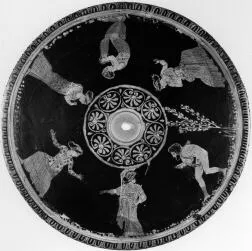
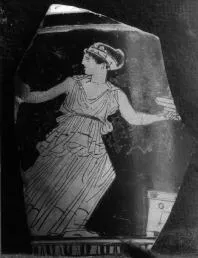
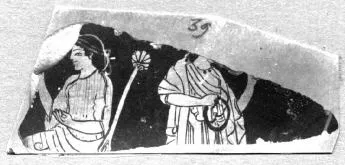
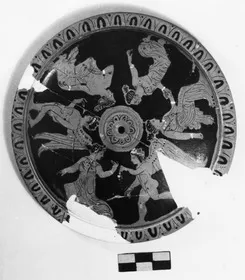
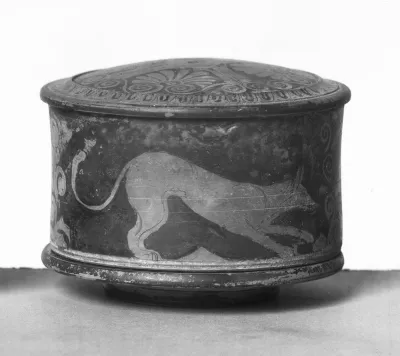
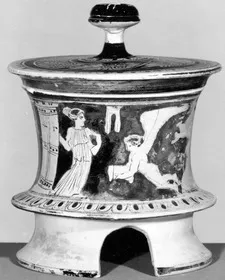
Pyxides with psimythia
National Archaeological Museum, Vase Collection, inv. no.
Α
13676a-b
,
Α
11332
Α 13676a-b
Provenance:
From Athens, from the foundation of a house opposite the Polytechnical School.
Dimensions:
Hight 11,7 cm. (13676a), 3,2 cm.(13676b)
Date:
410-400 B.C.
Display location:
Room
55
, Showcase
115
Α 1133
Provenance:
Tanagra (they are exhibited in a red-figure pyxis with a casket on the lid. Probably from Rhodes. Ca. 430 B.C. inv. no. Α 14797).
Date
:
End of 5
th
-end of 4
th
c. B.C.
Display location
:
Room
62
, Showcase
25
Historical sources indicate that women in antiquity used
psimythion
—a lead‑carbonate compound—to create the appearance of ideally fair skin. It is considered the earliest artificial cosmetic preparation known in the Greek world. From the 5th to the 3rd century BC, literary texts reveals that such cosmetic practices were often viewed with suspicion and criticized as deceptive. By contrast, naturally fair skin was celebrated as both an aesthetic ideal and a marker of social virtue.
The earliest reference to
psimythion
and its qualities appears in a passage by Xenophanes (6th–5th century BC)
[1]
, where its association with whiteness is explicitly highlighted. This link resurfaces later in Aristotle (
Nicomacheian
Ethics
1096b, 23), who notes that the whiteness of
psimythion
rivals that of snow.
The
psimythia
examined at the National Archaeological Museum fall into two distinct groups. The first consists of whole or fragmentary tablets stored in two pyxides, dated to 410–400 BC. The second group comprises 36
white‑lead pigments
recovered from burials in Tanagra, Boeotia, and likely dating from the late 5th to the late 4th century BC, based on the chronology of the associated tombs. To determine their composition, non‑destructive pXRF
[2]
analyses were first carried out on all the tablets, followed by XRD
[3]
analyses on three highly fragmentary samples, which confirmed that lead carbonate (cerussite, PbCO) is the predominant compon
National Archaeological Museum, Vase Collection, inv. no.
Α
13676a-b
,
Α
11332
Α 13676a-b
Provenance:
From Athens, from the foundation of a house opposite the Polytechnical School.
Dimensions:
Hight 11,7 cm. (13676a), 3,2 cm.(13676b)
Date:
410-400 B.C.
Display location:
Room
55
, Showcase
115
Α 1133
Provenance:
Tanagra (they are exhibited in a red-figure pyxis with a casket on the lid. Probably from Rhodes. Ca. 430 B.C. inv. no. Α 14797).
Date
:
End of 5
th
-end of 4
th
c. B.C.
Display location
:
Room
62
, Showcase
25
Historical sources indicate that women in antiquity used
psimythion
—a lead‑carbonate compound—to create the appearance of ideally fair skin. It is considered the earliest artificial cosmetic preparation known in the Greek world. From the 5th to the 3rd century BC, literary texts reveals that such cosmetic practices were often viewed with suspicion and criticized as deceptive. By contrast, naturally fair skin was celebrated as both an aesthetic ideal and a marker of social virtue.
The earliest reference to
psimythion
and its qualities appears in a passage by Xenophanes (6th–5th century BC)
[1]
, where its association with whiteness is explicitly highlighted. This link resurfaces later in Aristotle (
Nicomacheian
Ethics
1096b, 23), who notes that the whiteness of
psimythion
rivals that of snow.
The
psimythia
examined at the National Archaeological Museum fall into two distinct groups. The first consists of whole or fragmentary tablets stored in two pyxides, dated to 410–400 BC. The second group comprises 36
white‑lead pigments
recovered from burials in Tanagra, Boeotia, and likely dating from the late 5th to the late 4th century BC, based on the chronology of the associated tombs. To determine their composition, non‑destructive pXRF
[2]
analyses were first carried out on all the tablets, followed by XRD
[3]
analyses on three highly fragmentary samples, which confirmed that lead carbonate (cerussite, PbCO) is the predominant compon
Images courtesy of The Metropolitan Museum of Art (CC0)