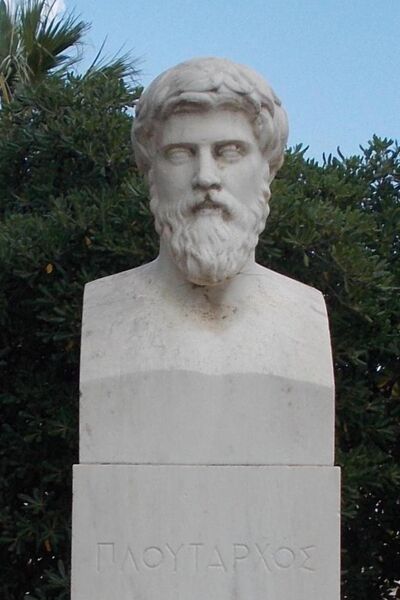
L. Mestrius Plutarchus
Plutarch
Antiquity's greatest biographer
c. 46 AD – c. 120 AD
Plutarch was born around 46 AD in Chaeronea, a small town in Boeotia where Philip of Macedon had crushed Greek liberty a century before his birth. He studied philosophy in Athens, visited Rome several times, and held a priesthood at Delphi, but he spent most of his life in Chaeronea, writing.
His Parallel Lives — paired biographies of famous Greeks and Romans — are among the most influential works in Western literature. Each pair compares a Greek and a Roman who shared some quality: Theseus with Romulus, Alexander with Caesar, Demosthenes with Cicero. The Lives are not critical history in the modern sense; they are moral portraits, designed to show character in action. Shakespeare drew the plots of Julius Caesar, Antony and Cleopatra, and Coriolanus directly from Plutarch in Thomas North's translation.
His Moralia — a vast collection of essays and dialogues on every conceivable subject, from the education of children to the intelligence of animals to the decline of oracles — reveal one of the most humane and civilised minds in antiquity. Plutarch is never profound in the way Plato or Aristotle is profound, but he is wise, warm, endlessly curious, and always readable.
Works (78)
-
1
Ad principem ineruditum biography
To an uneducated ruler. Plutarch warns that power without wisdom is dangerous — a ruler must govern himself before governing others.
-
2
Adversus Coloten biography
A reply to Epicurus' disciple Colotes, who had attacked all other philosophers. Plutarch defends the Academic and Peripatetic traditions against Epicu...
-
3
Amatoriae Narrationes biography
Love stories. Brief tales of romantic and erotic misadventure — passion, murder, and suicide in the Greek cities.
- 4
-
5
Animine an corporis affectiones sint peiores biography
Whether the afflictions of the soul are worse than those of the body. Plutarch argues that mental suffering is worse because we are more responsible f...
-
6
An Recte Dictum Sit Latenter Esse Vivendum biography
Against Epicurus' maxim "live unnoticed." Plutarch argues that withdrawal from public life is cowardly and contrary to human nature.
-
7
An seni respublica gerenda sit biography
Whether an old man should engage in politics. Plutarch argues yes — experience and wisdom are assets, and retirement from public life is premature sur...
-
8
An Virtus Doceri Possit biography
Can virtue be taught? A brief essay arguing that virtue requires both natural aptitude and education — neither alone is sufficient.
-
9
An vitiositas ad infelicitatem sufficia biography
Whether vice is sufficient for unhappiness. Plutarch argues that vice alone makes a person wretched, regardless of external circumstances.
-
10
Apophthegmata Laconica biography
Sayings of the Spartans. Brief, pointed remarks attributed to Spartan warriors, kings, and citizens. The original source for Spartan laconic wit.
-
11
Aquane an ignis sit utilior biography
Whether water or fire is more useful. A rhetorical debate on the relative value of the two elements.
-
12
Bruta animalia ratione uti biography
A dialogue in which Gryllus — one of Odysseus' men transformed into a pig by Circe — argues that animals are happier than humans. He refuses to be cha...
-
13
Comparationis Aristophanis et Menandri compendium biography
A comparison of Aristophanes and Menander, arguing that Menander is the superior dramatist. Only a summary survives.
-
14
Compendium argumenti Stoicos absurdiora poetis dicere biography
A brief argument that the Stoics say more absurd things than the poets. Plutarch attacks Stoic paradoxes as worse than poetic licence.
-
15
Conjugalia Praecepta biography
Advice to a newly married couple. Practical wisdom on managing a household, handling disagreements, and maintaining respect. Addressed to the bride an...
-
16
Consolatio ad Apollonium biography
A consolation addressed to Apollonius on the death of his son. Plutarch draws on Stoic, Platonic, and Epicurean arguments to show that grief, while na...
-
17
Consolatio Ad Uxorem biography
A consolation to his wife on the death of their daughter Timoxena. Written with genuine emotion — one of the most personal texts in the Plutarchan cor...
-
18
De Alexandri magni fortuna aut virtute biography
Two essays on Alexander the Great's fortune and virtue, arguing that Alexander was a philosopher in action, not merely a conqueror.
-
19
De amicorum multitudine biography
Against having too many friends. Plutarch argues that genuine friendship requires time and intimacy — spread yourself too thin and every friendship be...
-
20
De Amore Prolis biography
On love of offspring. Why parents love their children — and why this love is not merely instinctive but rational and virtuous.
-
21
De animae procreatione in Timaeo philosophy
On the creation of the soul in the Timaeus. A technical exegesis of Plato's cosmological dialogue, focusing on the mathematical composition of the wor...
-
22
De capienda ex inimicis utilitate biography
How to profit from your enemies. Hostility keeps you sharp, criticism reveals your faults, and rivals force you to improve. A characteristically Pluta...
-
23
De cohibenda ira biography
On controlling anger. Practical advice on managing a dangerous emotion — delay your response, lower your voice, consider the other person's perspectiv...
-
24
De communibus notitiis adversus Stoicos biography
Against the Stoic doctrine of common notions. Plutarch argues that Stoic philosophy violates ordinary moral intuitions.
-
25
De Cupiditate Divitiarum biography
On the love of wealth. Why greed is insatiable and why the pursuit of money cannot produce happiness.
-
26
De curiositate biography
On curiosity. Why some people are obsessed with other people's business, and how to redirect that energy toward self-examination.
-
27
De Defectu Oraculorum biography
Why are the oracles declining? A dialogue that ranges from demonology to cosmology, arguing that the spirits who animate the oracles are mortal and ca...
-
28
De E apud Delphos biography
What does the letter E inscribed at Delphi mean? A dialogue exploring symbolic, numerical, and philosophical interpretations. Characteristically Pluta...
-
29
De esu carnium I biography
On the eating of meat. Two connected essays arguing against meat-eating on grounds of compassion, health, and the kinship of all living things.
- 30
- 31
-
32
De Facie Quae in orbe Lunae Apparet oratory
The face on the Moon. A dialogue on the nature of the Moon, combining astronomy, physics, and Platonic mythology. Plutarch suggests the Moon is an ear...
- 33
-
34
De fortuna biography
A short essay on fortune — whether it is blind or purposeful, and how much of human success it controls.
-
35
De fortuna Romanorum biography
Is Rome's greatness due to fortune or virtue? Plutarch argues both — but fortune gets the larger share.
-
36
De fraterno amore biography
On brotherly love. Why siblings should maintain their bond despite the rivalries and resentments that family life produces.
-
37
De Garrulitate biography
On talkativeness. Plutarch catalogues the disasters caused by people who cannot stop talking — and offers practical remedies for the compulsion.
-
38
De Genio Socratis biography
On the divine sign of Socrates. A dialogue set during the Theban liberation, discussing Socrates' mysterious inner voice that warned him against certa...
-
39
De gloria Atheniensium biography
Was Athens more famous for war or wisdom? Plutarch makes the case for Athenian military glory against its cultural reputation.
-
40
De Heroditi malignate biography
On the malice of Herodotus. Plutarch accuses Herodotus of bias against the Boeotians and other Greeks — an extended exercise in patriotic literary cri...
-
41
De Invidia et Odio biography
On envy and hatred. A brief essay distinguishing the two emotions — envy targets the fortunate, hatred targets the wicked.
-
42
De Iside et Osiride biography
A detailed account of the Egyptian gods, especially Isis and Osiris. Plutarch interprets the myths philosophically, connecting them to Platonic theolo...
-
43
De liberis educandis biography
A treatise on educating children, emphasising character formation over mere instruction. Probably not by Plutarch, but widely read and influential.
-
44
De primo frigido biography
On the principle of cold. A scientific dialogue investigating whether cold is an active element or merely the absence of heat.
-
45
De Pythiae oraculis biography
Why does the Pythia no longer speak in verse? A dialogue about the decline of oracular poetry and what it means for the relationship between gods and...
-
46
De recta ratione audiendi biography
How to listen to a lecture. Practical advice on being a good student — pay attention, suppress your vanity, focus on content rather than style.
-
47
De Se Ipsum Citra Invidiam Laudando biography
On praising yourself without giving offence. When is self-praise justified, and how can it be done without alienating your audience?
-
48
De Sera Numinis Vindicta biography
On the delays of divine vengeance. Why do the gods allow the wicked to prosper? Plutarch argues that punishment is not always immediate — and that the...
-
49
De sollertia animalium biography
On the intelligence of animals. Plutarch argues that animals reason, communicate, and display virtues — challenging the Stoic view that animals are me...
-
50
De Stoicorum repugnantiis biography
On Stoic self-contradictions. Plutarch catalogues passages where the Stoics contradict their own doctrines — a sustained polemic from a committed Plat...
-
51
De Superstitione biography
A polemic against superstition. Plutarch argues that irrational fear of the gods is worse than atheism — the superstitious person lives in constant te...
-
52
De Tranquillitate Animi biography
On tranquillity of mind. How to achieve inner peace despite external circumstances. Plutarch recommends counting your blessings, avoiding envy, and re...
-
53
De tuenda sanitate praecepta biography
Health advice for the busy scholar. Plutarch recommends moderate exercise, simple food, and avoiding intellectual work immediately after eating.
-
54
De unius in republica dominatione, populari statu, et paucorum imperio philosophy
On monarchy, democracy, and oligarchy. A brief comparison of the three forms of government, with no clear winner.
-
55
De virtute et vitio biography
A brief essay on virtue and vice — arguing that virtue produces inner harmony while vice creates conflict within the soul.
-
56
De Virtute Morali biography
On moral virtue. Plutarch defines virtue as a state of the soul governed by reason — following Aristotle rather than the Stoics, who made virtue purel...
-
57
De vitando aere alieno biography
On avoiding debts. Plutarch argues that borrowing money is a form of slavery — the debtor lives at the mercy of the creditor.
-
58
De Vitioso Pudore biography
On false modesty. Why excessive diffidence is a vice that prevents people from saying no when they should.
-
59
Epitome libri de animae procreatione in Timaeo philosophy
An epitome of the essay on the creation of the soul in the Timaeus — a shorter summary of the longer work.
- 60
-
61
Lacaenarum Apophthegmata biography
Sayings of Spartan women — mothers, wives, and widows whose courage matched their sons' and husbands'.
-
62
Maxime Cum Principibus Viris Philosopho Esse Disserendum biography
That a philosopher should converse with rulers. Plutarch argues that philosophy is not a retreat from politics but should engage with power directly.
-
63
Mulierum virtutes biography
Famous deeds of women. Plutarch catalogues acts of courage, intelligence, and patriotism by women from across the Greek and barbarian world.
-
64
Non Posse Suaviter Vivi Secundum Epicurum biography
That it is impossible to live pleasantly according to Epicurus. Plutarch argues that the Epicurean withdrawal from politics, poetry, and divine provid...
-
65
Parallela minora biography
Minor parallels. Brief pairs of similar stories from Greek and Roman history, probably not by Plutarch. A collection of curious historical coincidence...
-
66
Parallel Lives biography
Twenty-two pairs of Greek and Roman biographies, plus four standalone Lives. Plutarch's masterwork of comparative biography, setting the greatest figu...
-
67
Platonicae quaestiones biography
Platonic Questions. Brief investigations into difficult passages in Plato's dialogues.
-
68
Praecepta gerendae reipublicae biography
Political precepts. Practical advice for aspiring politicians — how to enter public life, build alliances, handle criticism, and serve the state witho...
-
69
Quaestiones Convivales biography
Table-talk. Nine books of dinner-party conversations covering science, literature, ethics, and trivia. The format is Plutarch at his most sociable and...
-
70
Quaestiones Graecae biography
Greek Questions. Brief investigations into local Greek customs, legends, and place names — an antiquarian miscellany.
-
71
Quaestiones Naturales biography
Natural Questions. Brief investigations into natural phenomena — thunder, ice, salt water, tides. Plutarch as amateur scientist.
-
72
Quaestiones Romanae biography
Roman Questions. Why do Romans do what they do? Plutarch investigates 113 Roman customs and rituals, proposing explanations from history, religion, an...
-
73
Quomodo adolescens poetas audire debeat biography
How a young person should read poetry — with critical judgement, recognising that poets are not moral teachers. A guide to literary education.
-
74
Quomodo adulator ab amico internoscatur biography
How to distinguish a flatterer from a friend. The flatterer agrees with everything; the true friend tells uncomfortable truths. One of Plutarch's most...
-
75
Quomodo quis suos in virtute sentiat profectus oratory
How to recognise your own moral progress. Plutarch argues that self-improvement is gradual and often invisible — but there are signs to watch for.
-
76
Regum et imperatorum apophthegmata biography
Sayings of kings and commanders — aphorisms attributed to rulers from Artaxerxes to Augustus. A handbook of political wit.
-
77
Septem sapientium convivium biography
A dinner party of the seven sages of Greece — Thales, Solon, Bias, and the others — discussing wisdom, government, and practical philosophy over food...
-
78
Vitae decem oratorum biography
Lives of the ten Attic orators. Brief biographies from Antiphon to Dinarchus, preserving details found nowhere else. Almost certainly not by Plutarch.