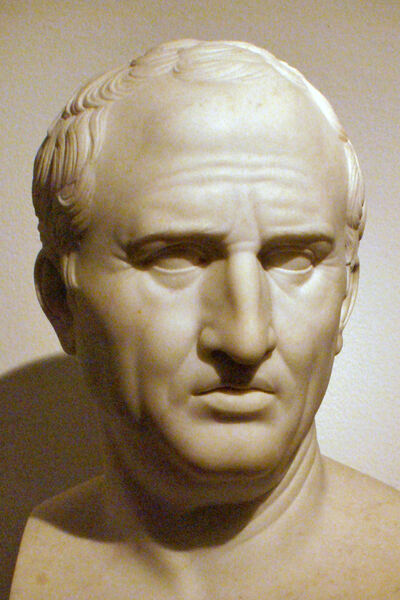
M. Tullius Cicero
Cicero
Rome's greatest orator and the voice of the Republic
106 BC – 43 BC
Marcus Tullius Cicero was born in 106 BC in Arpinum, a hill town southeast of Rome, into a prosperous equestrian family with no senatorial ancestors. He made his way to the top of Roman politics by talent alone — specifically, by the talent of speaking more persuasively than anyone else in a society where persuasive speech was the supreme political tool.
His rise was extraordinary. He won every magistracy at the earliest legal age (suo anno), culminating in the consulship of 63 BC, during which he suppressed the Catilinarian conspiracy — a genuine coup attempt that he foiled through a combination of intelligence work, oratory, and ruthless executive action. He had the conspirators executed without trial, a decision that would haunt him for the rest of his life.
His political career was a long struggle to defend the traditional Republican constitution against the strongmen who were tearing it apart: first Catiline, then the triumvirate of Caesar, Pompey, and Crassus, and finally Antony. He failed. The Republic died, and Antony had Cicero murdered in December 43 BC. His head and hands were displayed on the Rostra in the Forum, the very platform from which he had delivered his greatest speeches.
But Cicero's legacy is not primarily political. His speeches — fifty-eight survive — are the supreme achievement of Latin prose. His philosophical works, written in feverish haste during his final years, transmitted Greek philosophy to the Latin-speaking world and created the vocabulary in which Western philosophy would be conducted for centuries. His letters, over nine hundred of them, are the most vivid and intimate self-portrait to survive from the ancient world. Through them we know Cicero as we know no other ancient figure: vain, anxious, brilliant, deeply human.
Works (61)
-
1
Academica philosophy
The Academics examines the theory of knowledge: can we know anything with certainty? Cicero presents the arguments of the Academic sceptics and their...
-
2
Against Vatinius oratory
Cicero attacks the witness Vatinius during the defence of Sestius. A sustained personal assault disguised as cross-examination.
- 3
-
4
Cum populo gratias egit prose
Cicero's speech thanking the Roman people for supporting his recall from exile.
-
5
Cum Senatui gratias egit prose
Cicero's speech thanking the Senate for recalling him from exile. A passionate account of his suffering and the injustice of his banishment.
-
6
De Amicitia philosophy
What is a friend? Cicero's dialogue — spoken by Laelius after the death of his friend Scipio Aemilianus — is the most influential essay on friendship...
-
7
De Divinatione prose
Cicero investigates whether the gods communicate with mortals through signs and omens. A systematic demolition of Roman divination — augury, haruspicy...
-
8
De domo sua ad pontifices philosophy
Cicero argues before the pontifical college that Clodius had no right to consecrate the site of his demolished house. A legal-religious dispute that i...
-
9
De Fato philosophy
Can the future be predicted? Cicero demolishes Stoic arguments for divination — augury, dreams, astrology, oracles — with devastating logical analysis...
-
10
de Finibus Bonorum et Malorum philosophy
What is the highest good? Five books examining the ethical theories of Epicureans, Stoics, and the Old Academy. The most systematic philosophical work...
-
11
De haruspicum responso in P. Clodium oratory
Cicero responds to a hostile religious ruling by attacking Clodius. The haruspices said Rome was threatened by sacrilege — Cicero argues that Clodius...
-
12
De Imperio Cn. Pompei Ad Quirites philosophy
Cicero argues for giving Pompey extraordinary military command against Mithridates. His first major political speech — a master class in making the ex...
-
13
De Inventione philosophy
The first systematic Latin treatise on rhetoric. Two books covering invention — how to find arguments for any type of case. A youthful work that Cicer...
-
14
De Lege Agraria philosophy
Three speeches against the tribune Rullus' land-reform bill. Cicero, the newly elected consul, argues that the bill concentrates too much power in the...
-
15
de Natura Deorum philosophy
Do the gods exist? What are they like? Do they care about us? Three books presenting Epicurean, Stoic, and Academic arguments about the nature of the...
-
16
De Officiis philosophy
A father's letter to his son about how to live. Written in the last months of Cicero's life, addressed to his son Marcus studying in Athens, De Offici...
-
17
De Optimo Genere Oratorum philosophy
A preface to Cicero's translation of Demosthenes and Aeschines, arguing that the best translation captures the force of the original, not its literal...
-
18
De provinciis consularibus philosophy
Cicero argues that the Senate should assign the wealthy provinces of Syria and Macedonia to new governors, undermining Caesar's and Piso's commands.
-
19
De Republica philosophy
Cicero's attempt to do for Rome what Plato did for Athens. A dialogue on the ideal state, drawing on Roman history rather than abstract theory. Surviv...
-
20
De Re Publica philosophy
What is the best form of government? Cicero's answer — a dialogue set in 129 BC among Rome's leading men — argues for a mixed constitution balancing m...
-
21
De Senectute philosophy
A dialogue on old age, put into the mouth of Cato the Elder at eighty-four. Is old age miserable? Cato says no — it brings wisdom, freedom from passio...
-
22
Divinatio in Q. Caecilium oratory
A preliminary hearing to determine who should prosecute Verres. Cicero argues that he, not Caecilius, is the right prosecutor — and reveals the scale...
-
23
In Catilinam oratory
Four speeches that saved the Republic — or destroyed it, depending on your politics. In 63 BC, Cicero exposed Catiline's conspiracy to overthrow the s...
-
24
In C. Verrem oratory
The prosecution of Verres for his catastrophic governorship of Sicily. Extortion, theft of artworks, judicial murder. Cicero presents the evidence so...
-
25
In L. Calpurnium Pisonem oratory
A blistering attack on Piso's consulship and his conduct as governor of Macedonia. Political invective at its most sustained and personal.
-
26
Letters to Atticus letters
Nearly 400 letters from Cicero to his closest friend Atticus, spanning twenty-five years of Roman political crisis. Unguarded, intimate, and political...
-
27
Letters to Brutus letters
The correspondence between Cicero and Brutus in the months after Caesar's assassination. The letters capture the Republic's final crisis in real time.
-
28
Letters to his brother Quintus letters
Letters between Cicero and his brother Quintus, covering politics, literature, and family affairs. A window into the relationship between two brothers...
-
29
Letters to his Friends letters
Letters to friends, colleagues, and political allies. The collection reveals the human networks behind Roman politics — favours asked, debts acknowled...
- 30
-
31
On Oratory rhetoric
A dialogue on the ideal orator, featuring the great Roman speakers Crassus and Antonius debating what makes oratory an art. Three books that define Ro...
- 32
-
33
Paradoxa Stoicorum philosophy
Six paradoxes of Stoic ethics restated for a Roman audience: that virtue alone is good, that all sins are equal, that the wise man is always free. Cic...
-
34
Partitiones Oratoriae rhetoric
A dialogue on rhetorical theory in which Cicero and his brother explore how to structure arguments. A technical companion to De Inventione.
-
35
Philippicae oratory
Fourteen speeches against Mark Antony, delivered in the Senate after Caesar's assassination. Cicero gambled everything on the Republic's survival and...
-
36
Pro A. Caecina oratory
A defence in a complex inheritance case turning on points of civil law. Cicero combines legal argument with vivid character sketches.
-
37
Pro A. Cluentio oratory
A defence of Cluentius against a charge of poisoning, tangled in a web of family hatreds, bribery allegations, and procedural complexity. Cicero calls...
-
38
Pro Archia oratory
A defence speech for a Greek poet accused of claiming Roman citizenship illegally. Cicero's real subject is not the case but the case for literature i...
-
39
Pro Archia Poeta oratory
A speech defending the poet Archias' claim to Roman citizenship. Cicero uses the case as a launching pad for an impassioned defence of literature, poe...
-
40
Pro Cn. Plancio oratory
Cicero defends Plancius, accused of electoral corruption, and repays a personal debt — Plancius sheltered him during his exile.
-
41
Pro C. Rabirio Perduellionis Reo Ad Quirites oratory
Cicero defends Rabirius, charged with treason for his role in killing Saturninus thirty-seven years earlier. The real issue is whether the Senate's em...
-
42
Pro C. Rabirio Postumo oratory
Cicero defends Rabirius Postumus, charged with receiving money from the extortion of Egypt. The case connects to the broader scandal of Ptolemy's rest...
-
43
Pro Fonteio oratory
A defence of Fonteius, accused of extortion as governor of Gaul. Cicero argues that Gallic witnesses are unreliable and that Fonteius served Rome hono...
-
44
Pro L. Cornelio Balbos oratory
Cicero defends Balbus' claim to Roman citizenship, granted by Pompey. The speech addresses the legal foundations of Roman citizenship and the rights o...
-
45
Pro L. Flacco oratory
Cicero defends Flaccus against extortion charges arising from his governorship. The speech includes attacks on the credibility of Greek and Asian witn...
-
46
Pro L. Murena oratory
A defence of Murena, consul-elect, accused of electoral bribery. Cicero is simultaneously prosecuting Catiline's conspiracy — and argues that Rome can...
-
47
Pro M. Caelio oratory
Cicero defends Caelius against charges of assault and attempted poisoning, famously attacking the prosecutor's star witness Clodia — the "Palatine Med...
-
48
Pro M. Marcello oratory
Cicero praises Caesar's clemency in pardoning Marcellus. The speech marks his return to public life after years of silence under Caesar's dictatorship...
-
49
Pro M. Scauro oratory
A fragmentary defence of Scaurus, accused of extortion as governor of Sardinia.
-
50
Pro M. Tullio oratory
A defence speech for Marcus Tullius in a case involving property damage and violence. Fragmentary but showing early Cicero's handling of civil dispute...
-
51
Pro P. Quinctio oratory
Cicero's first civil case, defending Publius Quinctius in a property dispute. The argument turns on procedural technicalities, but the young advocate'...
-
52
Pro P. Sestio oratory
Cicero defends Sestius, charged with political violence, and uses the trial to define his ideal of the Roman statesman — the bonus vir who serves the...
-
53
Pro P. Sulla oratory
A defence of Sulla on charges of involvement in the Catilinarian conspiracy. Cicero must protect his own political allies while maintaining his reputa...
-
54
Pro Q. Ligario oratory
Cicero pleads with Caesar to pardon Ligarius, who fought against him in Africa. The speech is famous for its emotional appeal — Caesar was reportedly...
-
55
Pro Q. Roscio Comoedo oratory
A legal dispute over an actor's contract and the meaning of a financial partnership. Early forensic Cicero — technically precise and already commandin...
-
56
Pro Rege Deiotaro oratory
Cicero's last forensic speech, defending King Deiotarus of Galatia before Caesar. The king is accused of plotting to assassinate the dictator during a...
-
57
Pro S. Roscio Amerino oratory
Cicero's first major case: defending a young man accused of parricide in a politically charged trial. He takes on the defence when no one else will, i...
-
58
Pro T. Annio Milone oratory
Cicero defends Milo for killing Clodius on the Appian Way. He argues it was self-defence. The published version is far better than what he actually de...
-
59
Timaeus philosophy
Cicero's translation of Plato's Timaeus, the dialogue on the creation of the universe. Only fragments survive, but they show Cicero wrestling with the...
- 60
-
61
Tusculanae Disputationes philosophy
Five conversations at Tusculum on the fundamental questions of human life: the fear of death, the endurance of pain, the nature of grief, the passions...