
Gnathian Situla
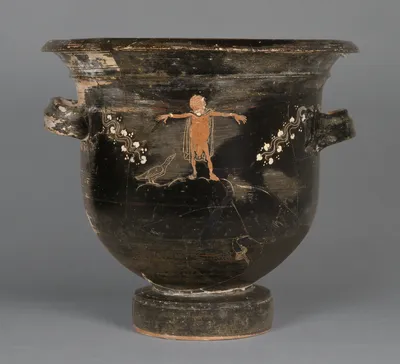
This bucket-shaped ceramic vessel would have been used for mixing and serving wine at a banquet. It has slightly convex sides, upright handles, and stands upon three low feet. The underside is reserved, as is the top of the lip, and the interior is painted black.
The situla is decorated in what scholars term the Gnathia technique, named after a site (modern Egnazia) in southern Italy at which examples were first found. In contrast to the more widespread red-figure technique, various colors – reds, yellows, whites – were applied directly to a pot’s black-painted surface, and details rendered with incision. On this vessel, a single figure stands upon a groundline consisting of two rows of dots, and an ivy bower hangs above. He wears a mask with a broad mouth, furrowed brows, a short beard, and golden hair topped by a berried wreath. Looking back, he gestures with one arm, extending the palm of his hand face down. Beneath his short (white) chiton and an (ochre yellow) himation is a (brown) body suit whose seams are visible at the wrist and ankles. Black sandals partially enclose his feet.
The figure’s mask and costume marks him as a character in a “phlyax” play. These plays, popular in the 300s and 200s B.C., often took a parodic or farcical stance on the Greek mythological pantheon, or elaborated upon the comic elements of everyday life. Surviving texts are almost completely fragmentary, but many vase-paintings from South Italy and Sicily testify to the popularity of these ribald performances. The term “phlyax”, which is used for both the play and the costumed actors, may derive from the Greek verb "to swell". It refers to the padded garments, baggy body-suits, and swollen phallus that were integral to the performers’ costumes.
Some scholars have seen the figure on this situla as a Black African, on account of the brown coloring of the body-suit (and also his exposed hand and feet), which differs from the off-white or light pink seen on Gnathia vessels that depict comparable characters (e.g., New York, Metropolitan [51.11.2](https://www.metmuseum.org/art/collection/search/254667), British Museum [1856,1226.112](https://www.britishmuseum.org/collection/object/G_1856-1226-112), or Boston MFA [00.363](https://collections.mfa.org/objects/154164)). Archaeological evidence, such as terracotta masks from Lipari (an island off the north coast of Sicily) that depict Greek and African characters, suggests that Black Africans may have featured on the stage. But skin color alone is insufficient to determine the ethnicity of this figure. When representing Black Africans, ancient artists also made use of stereotyped forms of hairstyle and facial features, or relied upon the specific context of a narrative scene. As this actor is depicted in isolation, we cannot situate him in a particular play. And for all of his mask’s exaggerated elements, the hairstyle, beard, wide-open mouth and many wrinkles do not differ from other, lighter-colored masks that caricature old men. An ancient viewer, however, may have known the episode depicted, and this vignette from the stage was well-suited to a vessel closely associated with Dionysos, god of wine and theater.
The situla is decorated in what scholars term the Gnathia technique, named after a site (modern Egnazia) in southern Italy at which examples were first found. In contrast to the more widespread red-figure technique, various colors – reds, yellows, whites – were applied directly to a pot’s black-painted surface, and details rendered with incision. On this vessel, a single figure stands upon a groundline consisting of two rows of dots, and an ivy bower hangs above. He wears a mask with a broad mouth, furrowed brows, a short beard, and golden hair topped by a berried wreath. Looking back, he gestures with one arm, extending the palm of his hand face down. Beneath his short (white) chiton and an (ochre yellow) himation is a (brown) body suit whose seams are visible at the wrist and ankles. Black sandals partially enclose his feet.
The figure’s mask and costume marks him as a character in a “phlyax” play. These plays, popular in the 300s and 200s B.C., often took a parodic or farcical stance on the Greek mythological pantheon, or elaborated upon the comic elements of everyday life. Surviving texts are almost completely fragmentary, but many vase-paintings from South Italy and Sicily testify to the popularity of these ribald performances. The term “phlyax”, which is used for both the play and the costumed actors, may derive from the Greek verb "to swell". It refers to the padded garments, baggy body-suits, and swollen phallus that were integral to the performers’ costumes.
Some scholars have seen the figure on this situla as a Black African, on account of the brown coloring of the body-suit (and also his exposed hand and feet), which differs from the off-white or light pink seen on Gnathia vessels that depict comparable characters (e.g., New York, Metropolitan [51.11.2](https://www.metmuseum.org/art/collection/search/254667), British Museum [1856,1226.112](https://www.britishmuseum.org/collection/object/G_1856-1226-112), or Boston MFA [00.363](https://collections.mfa.org/objects/154164)). Archaeological evidence, such as terracotta masks from Lipari (an island off the north coast of Sicily) that depict Greek and African characters, suggests that Black Africans may have featured on the stage. But skin color alone is insufficient to determine the ethnicity of this figure. When representing Black Africans, ancient artists also made use of stereotyped forms of hairstyle and facial features, or relied upon the specific context of a narrative scene. As this actor is depicted in isolation, we cannot situate him in a particular play. And for all of his mask’s exaggerated elements, the hairstyle, beard, wide-open mouth and many wrinkles do not differ from other, lighter-colored masks that caricature old men. An ancient viewer, however, may have known the episode depicted, and this vignette from the stage was well-suited to a vessel closely associated with Dionysos, god of wine and theater.
Images courtesy of The Metropolitan Museum of Art (CC0)