
Fragment of a Gnathian Bell Krater
The woman depicted on this small fragment of a vase probably represents one of the Muses, the goddesses of learning and the arts. She holds a lyre, a harp-like stringed instrument, and her posture suggests that she is seated. Richly dressed, this muse wears a mantle decorated with groups of three white dots over her dress, and her cloth headband is equally lavish. She also wears several pieces of jewelry: a diadem, earrings, a necklace, and bracelet.
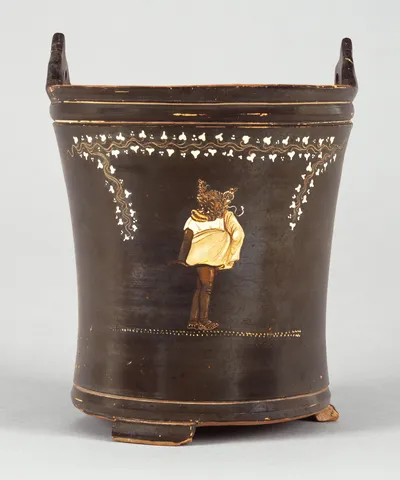
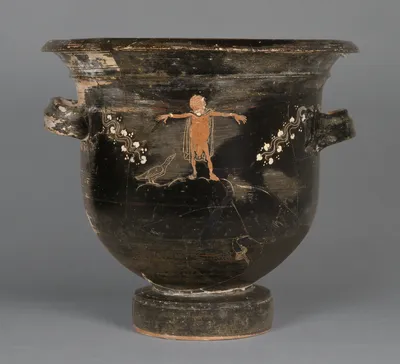
The fragment comes from a large krater decorated in a technique that scholars call Gnathian, after modern Egnazia, a site in southern Italy where examples were first found. The painter covered the entire surface of the vase with a black glaze and then added decoration over it. The bright, wide-ranging color palette seen on this fragment is typical of Gnathian pottery. Unusual, however, is the use of shading, such as the golden color that conveys the shape of the Muse’s forearm.
The fragment comes from a large krater decorated in a technique that scholars call Gnathian, after modern Egnazia, a site in southern Italy where examples were first found. The painter covered the entire surface of the vase with a black glaze and then added decoration over it. The bright, wide-ranging color palette seen on this fragment is typical of Gnathian pottery. Unusual, however, is the use of shading, such as the golden color that conveys the shape of the Muse’s forearm.
Images courtesy of The Metropolitan Museum of Art (CC0)