
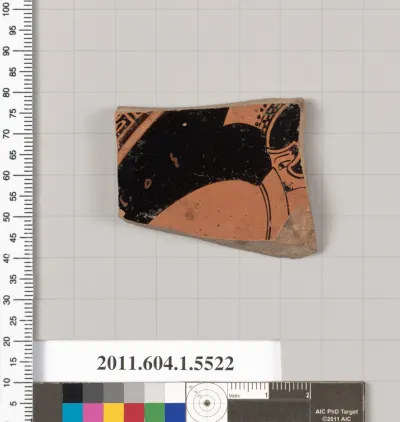
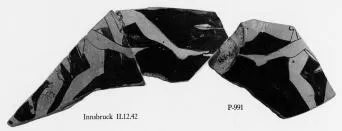
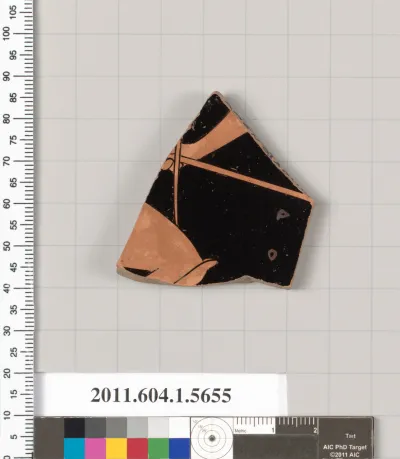
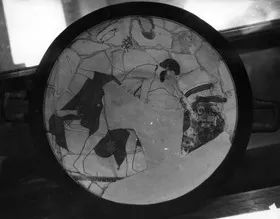
Attic White-Ground Cup (Lipped Inside) Fragment with Dionysos and a Satyr and One Black-Gloss Cup Fragment (rim)
This cup is one of the earliest vessels made that still preserves its white-ground interior. A large vase-painting entirely fills the inside of the bowl. It is rimmed by an offset black lip; the exterior of the cup is also black. Dionysos, shown to the left and dressed in a flowing white chiton and himation, is painted in red-figure outline upon the creamy white ground. Details, such as the folds of his linen garments, have been rendered in dilute gloss. The curly locks of the god's long hair and his kantharos are both painted black. A satyr playing an aulos approaches Dionysos from the right. Contrasting formally and iconographically with the ideal white god, his bestial acolyte is painted completely in the black-figure technique. Thus, the satyr's anatomical markings are rendered by incision, rather than drawn with gloss.
Because Dionysos was the god of wine, his activities were typically set in vineyards. Here, the grapevines are outlined by relief lines and colored with golden dilute wash. The bunches of grapes that hang from the vines are rendered in relief. Such three-dimensional grapes, common in Late Archaic red-figure vase-painting, are unprecedented in white ground representations.
A pioneer in the development of the red-figure style of vase-painting, Euphronios seems to have turned to potting later in his career. By the variety of shapes with which he is associated, we know that he potted vessels of exceptional size and complexity, including vases that combined the wheel-thrown, mold-made, and hand-formed techniques.
Because Dionysos was the god of wine, his activities were typically set in vineyards. Here, the grapevines are outlined by relief lines and colored with golden dilute wash. The bunches of grapes that hang from the vines are rendered in relief. Such three-dimensional grapes, common in Late Archaic red-figure vase-painting, are unprecedented in white ground representations.
A pioneer in the development of the red-figure style of vase-painting, Euphronios seems to have turned to potting later in his career. By the variety of shapes with which he is associated, we know that he potted vessels of exceptional size and complexity, including vases that combined the wheel-thrown, mold-made, and hand-formed techniques.
Images courtesy of The Metropolitan Museum of Art (CC0)