
Attic Red-Figure Calyx Krater Fragments (2)
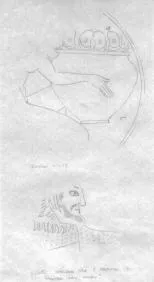
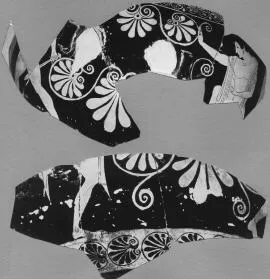
Only a few small fragments survive of what must once have been a magnificent red-figure calyx-krater. The fragments preserve part of Athena, the goddess of wisdom, and a decorative border of palmettes. Euphronios portrayed the goddess wearing a helmet and looking to the left. One arm is extended and covered by her aegis, her protective cloak edged with snakes.
Partially preserved inscriptions written in the background provide clues as to what the original scene on the krater might have been. They probably name Athena and Perseus, the Greek hero, indicating that the krater depicted Perseus, accompanied by his patron deity Athena, decapitating the gorgon Medusa.
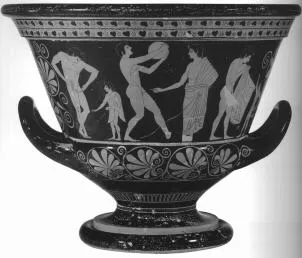
Euphronios worked in the new red-figure technique, which allowed painters greater ability to render realistic and three-dimensional representations of the human body. One element that allowed this was the fact that in red-figure the artist could draw interior details of figures either with dilute, normal, or thickened glaze, thereby giving them a sense of shading and mass. As can be seen here in Athena's hair, the dots of thick glaze standing up from the surface of the vase give the decoration a literal as well as visual three-dimensionality.
Partially preserved inscriptions written in the background provide clues as to what the original scene on the krater might have been. They probably name Athena and Perseus, the Greek hero, indicating that the krater depicted Perseus, accompanied by his patron deity Athena, decapitating the gorgon Medusa.
Euphronios worked in the new red-figure technique, which allowed painters greater ability to render realistic and three-dimensional representations of the human body. One element that allowed this was the fact that in red-figure the artist could draw interior details of figures either with dilute, normal, or thickened glaze, thereby giving them a sense of shading and mass. As can be seen here in Athena's hair, the dots of thick glaze standing up from the surface of the vase give the decoration a literal as well as visual three-dimensionality.
Images courtesy of The Metropolitan Museum of Art (CC0)