How Ancient Vases Were Made
The Athenian pottery industry of the sixth and fifth centuries BC produced tens of thousands of decorated vessels that were traded across the Mediterranean. This article traces the journey of a vase from clay pit to customer.
The Clay
Everything began with clay. Athens was fortunate in this respect: the beds around the Kerameikos quarter and along the river Eridanos provided a secondary clay rich in iron oxide and calcium oxide, which fired to the warm orange-red colour we recognise as characteristically Attic. Corinth, by contrast, had paler, creamier clay. The geological accident of Athens's clay is one reason Attic pottery came to dominate the Mediterranean market — the iron content made the three-stage firing process possible, and the colour was simply more attractive than the alternatives.
Raw clay, dug from open pits, was unusable. It contained stones, roots, organic matter, and sand. The potter's first task was purification through a process called levigation (Greek: ἐλυτρίασις). The clay was mixed with large quantities of water in settling basins. Heavier impurities sank to the bottom; lighter material floated to the surface and was skimmed off. The middle layer, a suspension of fine clay particles in water, was drawn off into a second basin. The process was repeated — sometimes many times. Each cycle produced finer, smoother clay.
After levigation, excess water was allowed to evaporate until the clay reached a workable consistency. But it was not yet ready. Fresh clay lacks the internal cohesion needed for throwing. It had to mature — to sit, damp and undisturbed, for weeks or even months, during which bacterial action and chemical changes improved its plasticity.
Finally, the clay was wedged — kneaded by hand, like bread dough, to expel trapped air and achieve an even consistency. Air bubbles in clay expand catastrophically in the kiln. Wedging was laborious but essential.
The same Attic clay, more finely levigated, also provided the material for the characteristic black slip (sometimes misleadingly called "glaze" — it is not a true glaze). This painting slip was produced by taking clay through many additional levigation cycles to isolate the finest particles, then adding a deflocculant — probably wood ash or urine — which broke the particles apart and prevented them from clumping. The result was a suspension so fine-grained that when applied to a vessel and fired, the particles sintered at a lower temperature than the coarser body clay, sealing the surface against the reintroduction of oxygen. This difference in sintering point is the entire basis of black-figure and red-figure technique.
The Workshop
The Athenian pottery industry was concentrated in the Kerameikos (Κεραμεικός), the potters' quarter in the northwest of the city, from which our word "ceramic" derives. The district lay along the banks of the Eridanos, whose clay deposits had drawn potters there since at least the Bronze Age.
A typical pottery was a small-to-medium operation — the proprietor (usually named as the potter, κεραμεύς), perhaps one or two additional potters, a painter or painters, and assistants. Some workshops were clearly family affairs; in others, the relationships were commercial. Slaves and metics (resident foreigners) worked alongside citizens.
The distinction between potter and painter is crucial. Some men were both — Exekias, the greatest black-figure artist, proudly signed as both potter and painter: Ἐξηκίας ἔγραφσε κἀποίησέ με ("Exekias painted and made me"). But increasingly the two roles were separate. A potter might supply vessels to several painters, or a painter might work within a single workshop.
The economics of the operation were modest. Prices scratched on vases (dipinti) suggest that even fine decorated vessels were cheap — perhaps one to three obols for a cup, a few drachmas at most for a large krater. A skilled labourer earned about one drachma per day. The profit was in volume, not margin.
The Wheel
Most Greek fine pottery was wheel-thrown. The Greek potter's wheel was a simple apparatus: a vertical axle topped by a broad, heavy horizontal disc. It was not a kick wheel of the modern type — the evidence strongly suggests that Greek wheels were hand-turned, either by the potter himself or, more commonly, by a seated assistant who kept the disc spinning while the potter worked with both hands.
Whether any Greek potters used a kick wheel remains debated. Homer's famous simile comparing dancers to a potter testing his wheel (Iliad 18.600–601) describes the potter fitting the wheel to his hands (παλάμῃσιν), not his feet. On balance, the standard Athenian workshop probably used the hand-turned wheel throughout the period of fine vase production.
The wheel turned — probably counterclockwise, based on the throwing marks visible on the undersides of surviving vessels. Most pots were thrown in sections. A cup might be thrown as a single bowl, with the stem and foot added separately. A large amphora was too big to throw in one piece; the upper and lower halves were thrown independently, allowed to dry to a leather-hard state, and then joined with slip.
The largest vessels — pithoi, monumental kraters — were too big for any wheel. These were built using the coiling method, with ropes of clay layered on top of one another and smoothed by hand, a technique that predated the wheel by millennia.
Development of Shapes
The Greek potter's repertoire was remarkably standardised. By the sixth century BC, roughly thirty recognised shapes were in production, of which perhaps a dozen were truly common.
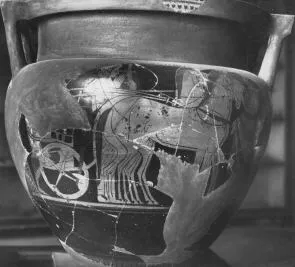
Shapes evolved in response to function, fashion, and the competitive dynamics of the market. The great majority of fine decorated vessels were connected to the symposium — the aristocratic drinking party that was the central social institution of Greek male life. The functional chain of the symposium dictated the shapes: amphorae for storing the wine; the krater for mixing wine with water; the psykter for cooling it; the kyathos for ladling; the oinochoe for pouring; and the kylix, skyphos, or kantharos for drinking.
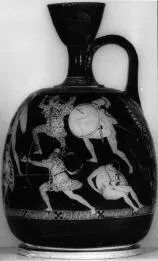
Outside the symposium, other shapes served other needs. The hydria had three handles — two for carrying, one for pouring. The lekythos, a slender oil flask, had powerful funerary associations. The pyxis was a woman's box for cosmetics and jewellery. The loutrophoros carried water for the bridal bath.
Shapes changed over time in recognisable ways. Across the Archaic and into the Classical period, bodies generally became slimmer and more elongated; feet grew more refined; handles became thinner and more elegant.
The full repertoire of Greek vase shapes is covered in our separate Guide to Greek Vase Shapes.
Decoration: Black-Figure and Red-Figure
Once thrown, joined, and dried to a leather-hard state, the vessel was ready for decoration. Two techniques dominated Athenian production: black-figure, developed in Corinth in the seventh century BC and perfected in Athens, and red-figure, invented in Athens around 530–520 BC.
Black-Figure
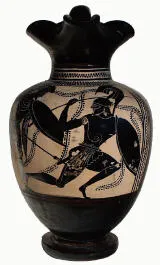
In the black-figure technique, the painter worked in positive. Figures were painted onto the natural red clay surface using the refined black slip. Internal details — muscles, drapery folds, facial features — were then incised into the painted surface with a sharp point, cutting through the black to reveal the red clay beneath.
Additional colours were sometimes added: white (a clay slip or lime wash) for women's skin and other highlights; a purplish-red for details like blood, hair, or garments. These subsidiary colours sat on top of the black slip and were applied before firing.
The great masters of black-figure — Exekias, the Amasis Painter, Lydos — pushed the technique to extraordinary heights. But the technique had inherent limitations. Incision could render anatomical detail only in a schematic, linear way; it could not easily suggest depth, modelling, or the fall of light on a three-dimensional form.
Red-Figure
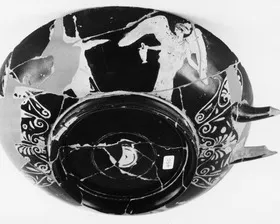
Red-figure reversed the logic. The painter outlined figures in the red clay, then filled in the background with black slip, leaving the figures in the natural reserved red. Internal details were now painted on — using the brush rather than the engraving tool. This seemingly simple reversal was revolutionary: the painter could now use a fine brush to add detail of any thickness, from bold outlines to hairline strokes in diluted slip that fired to a golden-brown. Foreshortening, three-quarter views, and the subtle rendering of anatomy all became possible.
The so-called Pioneers — Euphronios, Euthymides, and their circle — explored the new technique with competitive energy. Euthymides famously inscribed on one of his amphorae: ὡς οὐδέποτε Εὐφρόνιος — "as Euphronios never [could]."
Red-figure quickly displaced black-figure for most purposes, though black-figure continued for Panathenaic prize amphorae well into the fourth century.
Firing
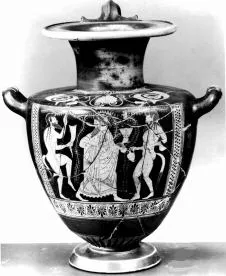
Firing was the most critical and technically demanding stage. A kiln-load of vessels — representing weeks of work by potters and painters — could be ruined by a single error in temperature or atmosphere.
The Athenian kiln was a simple updraft structure: a fire chamber below, separated by a perforated floor from the firing chamber above, with a domed roof pierced by a vent hole. Because Attic pottery uses no true glaze, vessels could be stacked touching each other.
The firing involved a single continuous process with three phases, manipulating the atmosphere inside the kiln to exploit the chemistry of iron in clay.
Phase 1 — Oxidation
With all vents open, the kiln was slowly heated over eight or nine hours to around 800–920°C. The oxygen-rich atmosphere converted the iron in both body clay and painted slip to red hematite (Fe₂O₃). Everything turned a bright orange-red.
Phase 2 — Reduction
At peak temperature, the vents were sealed and damp green wood was introduced. The fire, starved of oxygen, produced carbon monoxide — a reducing atmosphere. The red hematite converted to black magnetite (Fe₃O₄). The entire vessel turned black. Crucially, the temperature was held at around 945°C long enough for the fine-particled slip to sinter — for its particles to fuse into a continuous, impermeable surface. The coarser body clay did not sinter at this temperature; its surface remained porous.
Phase 3 — Reoxidation
The vents were opened again, oxygen flooded back in, and the temperature dropped to around 800–850°C. Oxygen penetrated the porous, unslipped surfaces, converting the iron back to red hematite — the body clay returned to orange-red. But the sintered slip, now sealed, could not absorb oxygen; its iron remained as black magnetite. The coated areas stayed black; the uncoated areas turned red.
This is the entire secret of both black-figure and red-figure vases. Same chemistry, same kiln, same firing — the difference is only which areas the painter chose to cover with slip.
The whole process, from initial heating to final cooling, probably took upwards of twenty-four hours. The potter judged temperatures not with instruments but by eye and by experience — the colour of the fire, the colour of the pots visible through the kiln's spy-hole, the smell of the smoke during reduction.
Marketing & Trade
Within Athens, pottery was sold in the Agora. The prices were low — this was everyday tableware for much of the Athenian population, not luxury goods in the modern sense, though the finest pieces clearly commanded higher prices.
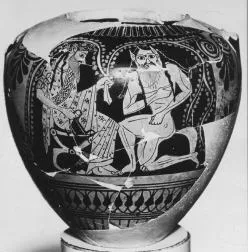
But the domestic market was only part of the story. From the sixth century BC onward, Athenian pottery was exported on a vast scale across the Mediterranean. The majority of surviving Attic red-figure vases have been found not in Athens but in Etruria — the homeland of the Etruscans, in central Italy, where Greek pottery was prized as prestige goods and placed in tombs. Over 73% of all known Attic stamnoi were found in Etruscan contexts.
This was not a passive overflow of surplus production. Athenian workshops actively targeted the export market. The Nikosthenic amphora, a distinctive shape produced by the potter Nikosthenes, copies an Etruscan metalwork form and was manufactured almost exclusively for the Italian market. Some workshops produced specific iconographies — Dionysiac scenes were particularly popular in Etruria, where the cult of Fufluns (the Etruscan Dionysos) was prominent.
Beyond Etruria, Attic pottery travelled to the Greek colonies of Southern Italy and Sicily, to Cyprus, to the Black Sea coast, to North Africa, and even to Spain. Different markets preferred different shapes and subjects.
By the fourth century, Athens's dominance was waning. Local production centres — in South Italy, in Etruria itself — had learned to produce their own red-figure wares. The vast export market that had sustained the Kerameikos workshops gradually contracted, and by the Hellenistic period, painted pottery had largely been displaced by other media.
Further Reading
- Boardman, J. Athenian Black Figure Vases (London, 1974)
- Boardman, J. Athenian Red Figure Vases: The Archaic Period (London, 1975)
- Boardman, J. Athenian Red Figure Vases: The Classical Period (London, 1989)
- Clark, A.J., Elston, M., & Hart, M.L. Understanding Greek Vases (J. Paul Getty Museum, 2002)
- Noble, J.V. The Techniques of Painted Attic Pottery (rev. ed., London, 1988)
- Richter, G.M.A. The Shapes and Names of Athenian Vases (New York, 1935)
- Hasaki, E. "Workshops and Technology" in Smith & Plantzos (eds.), A Companion to Greek Art (Oxford, 2012)
- Bundrick, S.D. Athens, Etruria, and the Many Lives of Greek Figured Pottery (University of Wisconsin Press, 2019)
Coming in this series
- The Black-Figure Technique in Detail
- The Red-Figure Revolution
- Individual Painters and Their Workshops
- Mythological Scenes on Greek Vases