
Apulian Red-Figure Volute Krater
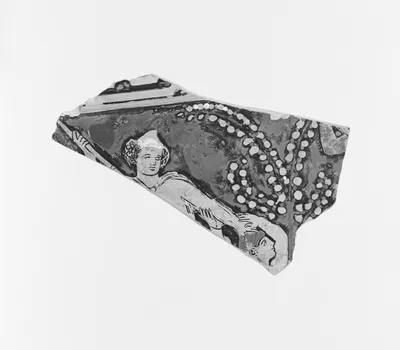
Funerary scenes decorate both sides of this Apulian red-figure volute-krater. On the front, a youth and a woman bring offerings to a naiskos, a small funerary shrine. A young man seated in the naiskos holds a theatrical comic mask. Both the naiskos and the seated youth are painted white in order to simulate marble or stone, an indication that the seated figure is actually a statue of the deceased. The mask and the scroll lying on the ground at his feet suggest that the deceased had been involved in the theater and performance. The back of the vase depicts a funerary stele with another pair of offering bearers.
The combination of two funerary scenes, one with a naiskos and one with a stele, was a popular motif on large Apulian funerary vessels of the later 300s B.C. Aside from the main scenes, most of the surface of this vase is covered with elaborate decoration. The intricate design on the neck with a satyr's head sprouting from tendrils, the florals under the handles, and the female heads in the handle volutes are all typical of the ornament favored in the Apulian "Ornate Style."
The combination of two funerary scenes, one with a naiskos and one with a stele, was a popular motif on large Apulian funerary vessels of the later 300s B.C. Aside from the main scenes, most of the surface of this vase is covered with elaborate decoration. The intricate design on the neck with a satyr's head sprouting from tendrils, the florals under the handles, and the female heads in the handle volutes are all typical of the ornament favored in the Apulian "Ornate Style."
Images courtesy of The Metropolitan Museum of Art (CC0)