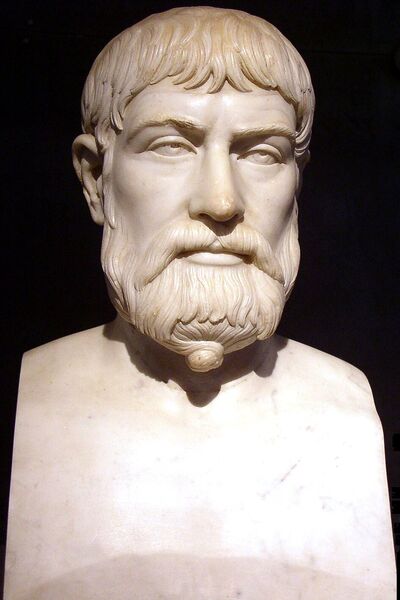
Pindarus
Pindar
The supreme lyric poet of Greece
c. 518 BC – c. 438 BC
Pindar was born around 518 BC in Cynoscephalae, near Thebes, into an aristocratic family. He was the greatest lyric poet of the Greek world — a status acknowledged in his own lifetime and never seriously challenged since. When Alexander the Great destroyed Thebes in 335 BC, he ordered Pindar's house to be spared.
He composed in nearly every lyric genre: hymns, paeans, dithyrambs, maiden songs, dirges, and victory odes. Only the victory odes survive complete — forty-five poems celebrating the winners of the four great Panhellenic athletic festivals: Olympia, Delphi (the Pythian games), Nemea, and the Isthmus. These are not simple sports reports. Each ode weaves together the victor's achievement, the mythology of his city, the nature of human excellence, and the relationship between mortal effort and divine favour into a dense, allusive, syntactically complex tapestry of language.
Pindar's style is famously difficult. His sentences can run for dozens of lines, pivoting on unexpected connections between myth and present, image and idea. His metaphors are bold to the point of audacity. His transitions are abrupt, his tone elevated, his diction archaic even by the standards of his own time. Ancient critics called his poetry an eagle's flight; imitators found themselves tumbling into the sea.
He died around 438 BC, having lived through the Persian Wars, the rise of Athenian democracy, and the beginning of the golden age he did not entirely approve of — Pindar was an aristocrat in temperament and politics, suspicious of the demos and devoted to the old values of birth, wealth, and divine grace.
Works (4)
- 1
- 2
- 3
- 4