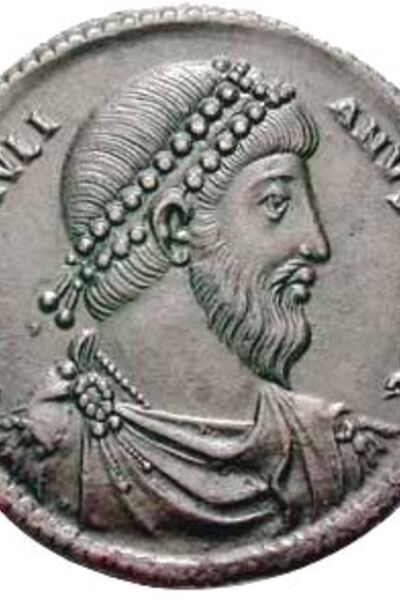
Flavius Claudius Iulianus
Julian
The last pagan emperor
AD 331 – AD 363
Flavius Claudius Julianus was born in 331 or 332 AD in Constantinople, the nephew of Constantine the Great. His childhood was shadowed by massacre — his father, uncle, and most of his male relatives were killed in the dynastic purges that followed Constantine's death in 337. Julian and his half-brother Gallus survived, were raised under strict Christian supervision, and educated in the Greek classics.
The classical education took. Julian secretly converted to traditional Graeco-Roman religion, probably around 351 AD, becoming the last pagan emperor. Elevated to Caesar in 355, he proved a brilliant military commander in Gaul before being proclaimed Augustus by his troops in 360. After the death of Constantius II in 361, Julian ruled alone for eighteen months before dying of a wound received fighting the Persians in June 363.
His surviving writings — orations, hymns, satires, letters, and the polemical Against the Galileans — reveal an intense, idealistic, and sometimes prickly intellectual. The Misopogon (Beard-Hater) is a unique work of imperial self-deprecation, and The Caesars is a witty symposium where the Roman emperors compete for a prize. Julian's eighty-two surviving letters are a treasure trove for the history of the fourth century. His attempt to restore paganism failed, but his writings remain the most articulate defence of the old religion produced in its final generation.
Works (14)
-
1
A Consolation to Himself Upon the Departure of the Excellent Sallust philosophy
A consolation written by Julian to himself when his friend Sallust was transferred away from him. Philosophy as self-help.
-
2
Epistolae philosophy
Julian's letters — to cities, officials, philosophers, and friends. They reveal the personality behind the policies of the last pagan emperor.
-
3
Hymn to King Helios Dedicated to Sallust poetry
A hymn to the Sun as supreme deity, interpreting solar theology through Neoplatonic philosophy. Julian's most systematic theological statement.
-
4
Hymn to the Mother of the Gods poetry
A hymn to the Mother of the Gods, interpreting the myth of Cybele and Attis as Neoplatonic allegory.
-
5
Letter to Themistius the Philosopher philosophy
Julian responds to the philosopher Themistius on the relationship between philosophy and political power. Can a ruler also be a philosopher? Julian in...
-
6
Letter to the Senate and the People of Athens philosophy
Julian writes to the Athenians defending his claim to the throne, recounting his mistreatment by Constantius II and his reluctant acceptance of power....
-
7
Misopogon philosophy
The Beard-Hater. Julian mocks the people of Antioch who ridiculed his philosopher's beard and his austere habits. The most self-aware piece of imperia...
-
8
Panegyric in Honor of the Emperor Constantinus oratory
A panegyric honouring the emperor Constantius, Julian's predecessor. Written before their relationship soured.
-
9
Panegyric on the Empress Eusebia philosophy
A eulogy of the empress Eusebia, who supported Julian at court.
-
10
The Caesars philosophy
The Caesars — a satirical dialogue in which the Roman emperors from Augustus to Constantine compete for prizes at a banquet of the gods. Witty and rev...
-
11
The Heroic Deeds of the Emperor Constantius, or on Kingship philosophy
A second panegyric to Constantius, presenting Julian's vision of ideal kingship.
-
12
To the Cynic Heracleios philosophy
A philosophical dialogue with the Cynic Heracleios on the proper use of myth and the meaning of Cynicism.
-
13
To the Uneducated Cynics philosophy
A polemic against false Cynics who disgrace philosophy through ignorance and shamelessness.
-
14
Κατὰ Γαλιλαίων philosophy
Against the Galileans — Julian's systematic critique of Christianity. He attacks its theology, its scriptures, and its claim to supersede Judaism and...