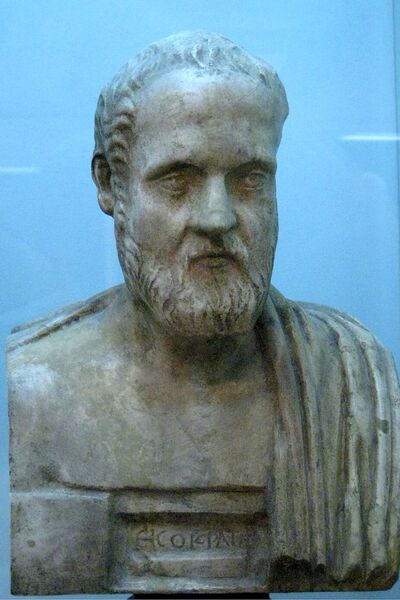
Isocrates
Isocrates
Athens's great teacher of rhetoric
436 BC – 338 BC
Isocrates was born in 436 BC in Athens, the son of a prosperous flute-maker. Too shy to speak in public — his voice was weak and his nerves unreliable — he became instead the most influential teacher of rhetoric in the Greek world, running a school in Athens for over fifty years.
Twenty-one of his speeches survive, though most were written for publication rather than delivery. His style is elaborate, periodic, and consciously artistic — he is said to have spent ten years polishing his Panegyricus, a call for Greek unity against Persia. His political programme — pan-Hellenic unity under a strong leader — was eventually realised, though not by the leader he had in mind: Philip of Macedon achieved what Isocrates had advocated, but at the cost of Greek freedom.
Isocrates died in 338 BC, reportedly by voluntary starvation, shortly after the Battle of Chaeronea. He was ninety-eight years old.
Works (30)
- 1
- 2
-
3
Against Euthynus oratory
A prosecution against Euthynus for financial misconduct. Brief and fragmentary.
- 4
-
5
Against the Sophists philosophy
Against the Sophists. Isocrates attacks rival teachers of rhetoric and philosophy, distinguishing his own educational programme from theirs.
- 6
-
7
Archidamus oratory
Archidamus, prince of Sparta, argues against surrendering Messenia. A deliberative speech put in the mouth of a Spartan king.
-
8
Areopagiticus oratory
Isocrates argues that Athens should restore the Areopagus council and return to the moral seriousness of earlier generations.
- 9
-
10
Concerning the Team of Horses oratory
Alcibiades' son defends his father's acquisition of a chariot team and his family's record of public service.
- 11
- 12
-
13
Nicocles or the Cyprians oratory
Nicocles addresses his subjects, explaining why monarchy is the best form of government and what they owe their king.
-
14
On the Peace oratory
An argument for peace with Athens' allies. Isocrates criticises Athenian imperialism and naval aggression.
-
15
Panathenaicus oratory
Isocrates' last major work, written at age ninety-seven. A comprehensive defence of Athens' historical record, responding to critics who favoured Spar...
-
16
Panegyricus oratory
The greatest speech in the Isocratean corpus. A call for the Greek states to unite under Athenian leadership against Persia — the Panhellenic ideal ex...
- 17
- 18
- 19
- 20
-
21
To Demonicus oratory
Advice to a young man named Demonicus on how to live well. Isocrates' most accessible work — a collection of practical moral maxims.
- 22
-
23
To Nicocles oratory
Advice to Nicocles, king of Cyprus, on how to rule well. A mirror for princes — moderate, practical, and humane.
- 24
-
25
To Philip, I oratory
A letter to Philip of Macedon after the battle of Chaeronea, urging him to lead a Panhellenic campaign.
- 26
- 27
- 28
- 29
-
30
Trapeziticus oratory
A banking fraud case. The speaker accuses a Pontic banker of stealing his deposit.