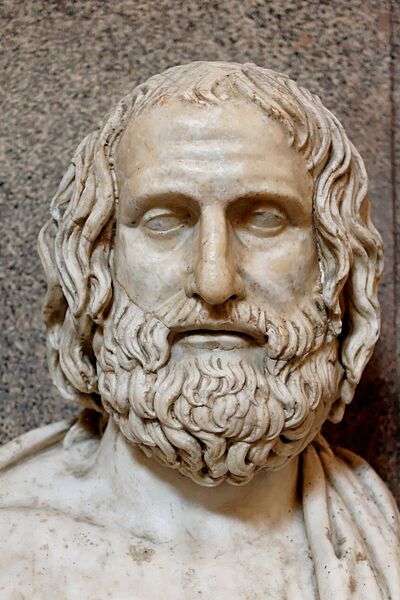
Euripides
Euripides
The most modern of the ancients
c. 480 BC – 406 BC
Euripides was born around 480 BC — tradition places his birth on the day of the Battle of Salamis, which is too neat to be true. He came from a respectable Athenian family, though the comic poets liked to claim his mother sold vegetables. He first competed at the Great Dionysia in 455 BC and won his first victory in 441, but he won only four more times during his lifetime — a record of relative failure that suggests his work was too disturbing for Athenian taste.
Of his approximately ninety plays, nineteen survive — more than for any other Greek tragedian, thanks partly to a lucky alphabetical selection that preserved a run of plays beginning with the letters E through K. They include some of the most powerful works in Western drama: the Medea, the Bacchae, the Hippolytus, the Trojan Women, the Electra, the Hecuba.
Euripides was the great iconoclast of Athenian tragedy. Where Aeschylus sought the justice of the gods and Sophocles explored human dignity under divine pressure, Euripides questioned everything. His gods are petty and cruel. His heroes are flawed, his heroines are dangerous, and his chorus often seems bewildered by the action. He gave women and slaves a voice on the tragic stage with an empathy that scandalized his contemporaries. Aristophanes parodied him relentlessly in the Frogs and other comedies.
He left Athens around 408 BC for the court of King Archelaus of Macedon, where he died in 406 BC — reportedly torn apart by the king's hunting dogs, though this is almost certainly legend. The Bacchae, his last and perhaps greatest play, was produced posthumously.
Works (19)
- 1
-
2
Andromache drama
Andromache, widow of Hector and now a slave, faces death at the hands of Hermione and Menelaus. The politics of the household mirror the politics of n...
- 3
- 4
- 5
- 6
- 7
-
8
Heracleidae drama
The sons of Heracles flee persecution and beg Athens for protection. Athens chooses to fight rather than surrender suppliants — but the cost of that c...
- 9
-
10
Hippolytus drama
Phaedra is consumed by an uncontrollable passion for her stepson Hippolytus. He is disgusted. She hangs herself and leaves a note accusing him. Theseu...
- 11
-
12
Iphigenia in Aulis drama
Agamemnon has summoned his daughter Iphigenia to Aulis on the pretext of marriage to Achilles. In truth, the army demands her sacrifice so the fleet c...
-
13
Iphigenia in Tauris drama
Iphigenia was sacrificed at Aulis — or was she? She is alive, serving as a priestess among the Taurians, sacrificing every Greek who lands on their sh...
- 14
- 15
- 16
-
17
Suppliants drama
The women of Argos march on Thebes to recover the bodies of their dead sons, denied burial after the Seven's failed siege. Theseus and Athens interven...
-
18
The Phoenician Women drama
Oedipus' sons fight over Thebes. Jocasta tries to mediate. Eteocles and Polynices kill each other. The curse reaches its conclusion in Euripides' long...
-
19
The Trojan Women drama
The women of Troy are divided among the Greek victors. Hecuba, Cassandra, and Andromache face slavery. Astyanax, Hector's infant son, is thrown from t...
Lost & Fragmentary Works
-
Lost PlaysTragedy
Euripides wrote approximately 90 plays, of which 18 tragedies and 1 satyr play (Cyclops) survive. The lost plays include several for which substantial papyrus fragments exist.
Originally: ~90 plays. Surviving: 19 complete plays; significant papyrus fragments of Hypsipyle, Phaethon, and others.
Kannicht, Tragicorum Graecorum Fragmenta, vol. V (Göttingen, 2004)