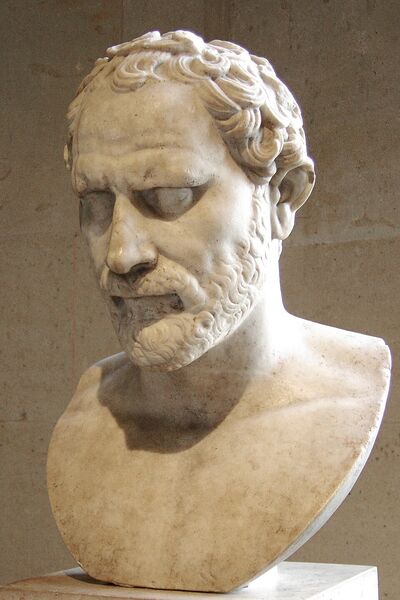
Demosthenes
Demosthenes
The greatest orator of the Greek world
384 BC – 322 BC
Demosthenes was born in 384 BC in Athens. His father, a wealthy arms manufacturer, died when he was seven, and his guardians embezzled most of the estate. At eighteen Demosthenes sued them — and won. The experience gave him both his career and his ferocity: he became the most formidable advocate and political orator Athens ever produced.
He is said to have overcome a speech impediment by practising with pebbles in his mouth and declaiming over the sound of the waves. The story may be apocryphal, but the discipline it represents was real. His speeches are monuments of forensic precision and rhetorical power — every argument marshalled, every emotion calibrated, every rhythmic effect calculated.
His greatest speeches are the Philippics and Olynthiacs, delivered between 351 and 341 BC, warning Athens of the threat posed by Philip II of Macedon. Demosthenes saw what most Athenians refused to see: that Philip was not a barbarian chieftain to be ignored but a strategic genius who was systematically dismantling Greek independence. He was right, and he was too late. Athens and its allies were defeated at Chaeronea in 338 BC, and Greek freedom effectively ended.
Demosthenes continued to resist Macedonian domination after Philip's death and Alexander's succession. When the Macedonians finally closed in, he took poison rather than be captured. He died in 322 BC. The ancient world considered him the supreme model of the political orator — Cicero studied and imitated him relentlessly.
Works (63)
-
1
Against Androtion oratory
Demosthenes prosecutes Androtion for proposing an illegal decree. A procedural case with political undertones.
- 2
-
3
Against Aphobus I oratory
Demosthenes' earliest speech. As a young man, he prosecutes Aphobus, his guardian, for embezzling his inheritance. The case launched his career as an...
-
4
Against Aphobus II oratory
The second speech against Aphobus, continuing the prosecution for guardianship fraud.
- 5
-
6
Against Aristocrates oratory
A prosecution of Aristocrates for an illegal decree protecting a Thracian mercenary captain. The speech includes a detailed survey of homicide law.
-
7
Against Aristogeiton I oratory
A prosecution of Aristogeiton, a notorious public debtor. The speech attacks his character with sustained venom.
- 8
- 9
- 10
-
11
Against Callicles oratory
A prosecution of Callicles for diverting water onto a neighbour's property.
-
12
Against Conon oratory
A prosecution of Conon for assault — one of the most vivid accounts of street violence in Athens.
- 13
-
14
Against Eubulides oratory
A defence against disenfranchisement, arguing that the speaker was wrongly struck from the citizen rolls.
-
15
Against Evergus and Mnesibulus oratory
A prosecution of Evergus and Mnesibulus for violent seizure of property.
-
16
Against Lacritus oratory
A prosecution of Lacritus for refusing to repay a maritime loan, with a surviving contract quoted in full.
- 17
-
18
Against Leptines oratory
A speech against Leptines' law abolishing tax exemptions. Demosthenes argues that Athens must honour its promises to benefactors.
- 19
-
20
Against Meidias oratory
Demosthenes prosecutes Meidias for assaulting him at the Dionysia. The speech transforms a personal grievance into a defence of democratic law — no ci...
-
21
Against Nausimachus and Xenopeithes oratory
A prosecution against Nausimachus and Xenopeithes for reviving a settled claim.
-
22
Against Olympiodorus oratory
A prosecution of Olympiodorus for cheating his partner in an inheritance division.
-
23
Against Onetor I oratory
Demosthenes prosecutes Onetor for obstructing the recovery of property from Aphobus.
- 24
- 25
-
26
Against Phaenippus oratory
A prosecution of Phaenippus for evading liturgy obligations by understating his wealth.
- 27
- 28
-
29
Against Stephanus I oratory
A prosecution of Stephanus for giving false testimony in the Phormio case.
- 30
- 31
-
32
Against Timocrates oratory
Demosthenes prosecutes Timocrates for passing a law to protect embezzlers from punishment.
-
33
Against Zenothemis oratory
A maritime fraud case. Demosthenes prosecutes Zenothemis for falsely claiming ownership of a grain cargo.
- 34
-
35
Apollodorus Against Callippus oratory
A prosecution of Callippus for fraudulently claiming a bank deposit.
-
36
Apollodorus Against Nicostratus oratory
A prosecution of Nicostratus for seizing property without legal authority.
-
37
Apollodorus Against Polycles oratory
A prosecution of Polycles for refusing to relieve his predecessor in a trierarchy command.
-
38
Apollodorus Against Timotheus oratory
A prosecution of Timotheus, the general, for failing to repay a debt to the banker Pasion.
- 39
-
40
First Olynthiac oratory
Demosthenes' first public speech, urging Athens to resist Philip of Macedon while there is still time. The argument is simple: act now or lose everyth...
-
41
First Philippic oratory
Demosthenes' first direct attack on Philip of Macedon. He argues that Philip is not invincible — Athens has simply stopped trying.
-
42
For Phormio oratory
A defence speech for the banker Phormio against claims on his estate. One of the most important sources for Athenian banking practice.
-
43
For the Liberty of the Rhodians oratory
Demosthenes urges Athens to support the Rhodian democrats against oligarchic oppression. Athens should defend democracy everywhere, not just at home.
-
44
For the People of Megalopolis oratory
Demosthenes argues that Athens should support Megalopolis against Spartan aggression, balancing power in the Peloponnese.
-
45
Fourth Philippic oratory
A fourth speech against Philip, possibly assembled from drafts. It repeats and amplifies the themes of the earlier Philippics.
- 46
-
47
On Halonnesus oratory
A speech attributed to Demosthenes on the island of Halonnesus, probably by Hegesippus. It rejects Philip's offer to "give" Athens an island Philip ha...
-
48
On Organization oratory
Demosthenes argues for political and financial reorganisation to meet the threat from Persia and Macedon.
-
49
On the Chersonese oratory
Demosthenes demands Athens act against Philip's seizure of the Chersonese. The question is no longer whether to fight but whether Athens will fight wh...
-
50
On the Crown oratory
Demosthenes' masterpiece and the greatest forensic speech in Greek. He defends his entire political career against Aeschines' prosecution, arguing tha...
-
51
On the False Embassy oratory
Demosthenes prosecutes Aeschines for misconduct during the embassy to Philip. He accuses Aeschines of accepting bribes and betraying Athenian interest...
-
52
On the Navy-Boards oratory
A speech on Athenian naval organization, arguing for reform of the trierarchy system.
-
53
On the Peace oratory
Demosthenes argues that the Peace of Philocrates has given Philip everything and Athens nothing. The peace is unjust, but breaking it prematurely woul...
-
54
On the Treaty with Alexander oratory
A speech on the treaty with Alexander, probably not by Demosthenes. It argues against the terms imposed after Chaeronea.
-
55
On the Trierarchic Crown oratory
A dispute over a trierarchic crown — the honour given for naval service.
-
56
Philip’s Letter oratory
Philip's letter to Athens, preserved in the Demosthenic corpus. The Macedonian king states his grievances against Athens.
-
57
Second Olynthiac oratory
The second appeal to defend Olynthus against Philip. Demosthenes proposes redirecting festival funds to the military. Athens debates while Philip adva...
-
58
Second Philippic oratory
Philip has broken the peace and threatens Thrace. Demosthenes urges Athens to defend the Chersonese and confront Macedonian expansion.
-
59
The Erotic Essay oratory
An erotic essay, almost certainly spurious, attributed to Demosthenes. A rhetorical exercise in the epideictic style.
-
60
The Funeral Speech oratory
A funeral oration for the Athenian dead, in the tradition of Pericles' speech. Probably not by Demosthenes.
-
61
Theomnestus and Apollodorus Against Neaera oratory
A prosecution of Neaera for falsely claiming Athenian citizenship. The speech provides the most detailed surviving account of the lives of courtesans...
-
62
Third Olynthiac oratory
The final plea for Olynthus. Demosthenes warns that Philip's power grows with every Athenian delay. Olynthus fell before Athens could act.
-
63
Third Philippic oratory
Demosthenes' most aggressive speech against Philip. He lays out the entire case: Philip's broken promises, his territorial gains, and Athens' failure...