
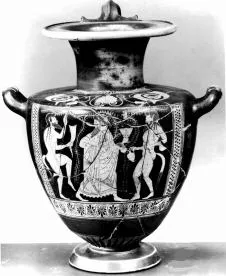
Water jar (hydria)
Scene from Attic Middle Comedy or a local play in the Attic tradition. Two comic actors face each other in a high-steppig dance. Both wear expressive, bearded masks, trousers, padded tunics, and mock phalli. The tunics and phalli are tinted with dilute glaze. The stage is not represented, and there is no clue to the theme of the play. The panel has elaborate frames; slanted and addorsed palmettes above, an ivy vine on the left side, a laurel wreath on the right, and a wave-pattern below. VASE PAINTING in ITALY, #80 (03.831) Hydria Perhaps from the Cassandra-Parrish Workshop about 360-350 B.C. Phylax scene. Two comic actors face each other in a high-stepping dance. Both wear expressive, bearded masks, trousers, padded tunics, and mock phalli. The tunics and phalli are tinted with dilute glaze. The stage is not represented, and there is no clue to the theme of the play. The panel has elaborate frames: slanted and addorsed palmetes above, an ivy vine on the left side, a laurel wreath on the right, and a wave-pattern below. The palmettes are of a type not found after mid-century; a relatively early date is also indicated by the careful draftsmanship, the absence of filling ornament, and the geometric composition. Trendall classes the masks as type B; compare the mask worn by the actor on the Apulian oinochoe, cat. no. 20.


Images courtesy of The Metropolitan Museum of Art (CC0)