
Mixing bowl (calyx-krater)
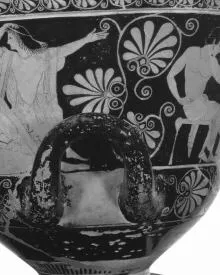
Close to the Darius Painter (Trendall); Close to the Hippolyte Painter (Padgett and Herrmann) A. At the center, Dionysos is seated on his cloak and leaning against some striped cushions. He wears a bracelet and holds a phiale in his right hand. In his left hand he holds a thyrsos with a yellow shaft and a tip in added red and brown. He is crowned by a flying Eros, who holds a smaller phiale. Eros wears a kekryphalos and yellow bracelets and anklets. A dappled fawn, its pelt tinted with brown dilute glaze, reclines next to Dionysos and looks back toward the god. A maenad, wearing a diaphanous dotted chiton, bracelets, and earrings, and a necklace with white pendants, dances at the right. She carries a thyrsos in her left hand and a torch with a trailing fillet in her right. A feline skin, which is colored with added red on one side and added yellow on the other, dangles from her left arm. At the left a young Pan is laying a calyx-krater decorated with figures in added yellow at the god's feet. The animal skin pinned at the satyr's throat flies in the wind behind him. A phiale and a white lyre with yellow details lie in the foreground on either side of a small grotto with a rocky border. Ivy hangs from the upper frame, and a rosette floats in the field at the upper left. The terrain throughout is indicated by short goundlines of yellow dots. B: A young satyr, standing to the right with his left foot on a yellow rock, holds out in his right hand a white kantharos with yellow shading and in his left a wreath and yellow fillet. He offers them to a female seated on a rock, who holds a large phiale in her right hand; in her lowered left hand is a long laurel branch with a pendant fillet. She wears a chiton, shoes, earrings, bracelets, a kekryphalos, and a necklace with white pendants. The satyr wears a yellow fillet and shoes. Two fillets and a "window" fill the field at the top, and a laurel bush grows at the left, behind the satyr. A row of yellow dots represents the groundline. A wreath of laurel circles the vase below the lip. The lower frame on side A consists of rosettes with yellow centers over a band of egg-pattern; on side B, there are linked maeanders to left, with a dotted cross-square in the center. The Hippolyte Painter was a forerunner of the Darius Painter. Very few vases have been attributed to him or to his associate the Laodamia Painter. Compare the decorated krater, the diaphanous chiton of Ariadne, the scattered implements, thick white fillets, and subsidiary ornament of the painter's calyx-krater in Basel (BS 468: "RVAp", II, p. 480, no. 18/13, pl. 170, 3-4). (text from Vase-Painting In Italy, catalogue entry no. 39)

Images courtesy of The Metropolitan Museum of Art (CC0)