
Mixing bowl (bell-krater)
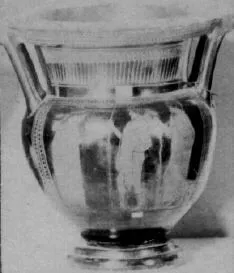
A: Three women are assembled in a room (to judge by the window-like square at the upper left). The white skin of the women is badly worn and blends confusingly with their hair and kekryphaloi, which are also white. All three wear chitons, and the two at left and right also wear himatia of added white. The woman standing in the center gazes into a yellow mirror held in her right hand; in her lowered left hand is a yellow situla. Her chignon is secured with a long white fillet. She turns toward the woman at the left; between them is a yellow thymiaterion, over which hangs a beaded fillet. The woman at the right, seated on a white stool covered with a yellow feline skin, holds a beribboned thyrsos in her left hand and a cista full of offerings in her right: two white sprigs, two yellow pomegranates, and a cake outlined in white. A yellow bird stands on her lap; it looks more like a goose than a crane, but the latter was a popular women's pet. The cista, the situla, and the thymaterion suggest the preparation for a sacrifice, to take place at an altar outdoors; the thyrsos and the feline skin suggest the recipient may be Dionysos. B: Three youths wearing himatia and white fillets stand in conversation, one facing right and two facing left. They are enveloped in their ample cloaks, which they pull taut in front with their right arms. In the upper field at left and right are two "windows"; two cistas decorated with yellow dots hang between the heads of the youths. A laurel wreath circles the vase below the rim. The groundline circling the lower body consists of a band of wave-pattern. The clay of both bands has been tinted with a red wash that contrasts with the beige of the figure zone. There are large palmettes under the handles, the roots of which are encircled by tongues. The Boston Ready Painter was among the minor followers of the CA Painter, active during the period when the workshop was under strong Apulian influence. The beefy, draped youths on the reverse are repeated on several bell-kraters, where the women also find parallels (e.g., Michigan 28809 and Naples RC 41: Trendall, LCS, p. 516, nos. 609, 614, pl. 201, 3-6). (text from Vase-Painting in Italy, catalogue entry no. 92)

Images courtesy of The Metropolitan Museum of Art (CC0)