Fragmentary Attic Black-Figure Neck Amphora
A, Herakles and the Lion. In the center, a naked Herakles wrestles with the Nemean Lion. The two struggle in an upright position. With his left arm Herakles chokes the lion, his clenched left hand pressing against the lion's open mouth. In his raised right hand the hero wields his club, but his sword is in its scabbard, suspended by a baldric slung over his right shoulder. The lion's left foreleg is extended forward, crossing Herakles' left thigh. One of the lion's hind legs claws at the air, and the other (now missing) must be on the ground. Behind Herakles, Athena stands to right. She wears a high-crested Attic helmet with fillet and is garbed in her aegis, which is worn over her peplos but under a bolero-like garment. The goddess holds her spear diagonally in her right hand, point upward, and she gestures in Herakles'direction with her left hand. Behind the lion, a man (head, upper body, and feet preserved), presumably lolaos, stands to left, clothed in a himation. He holds a club in his left hand and perhaps carries a quiver on his right hip.
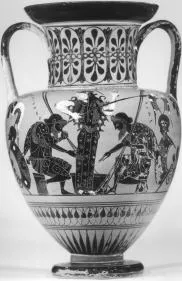
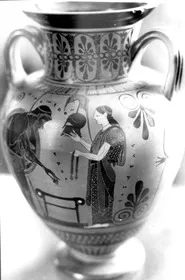
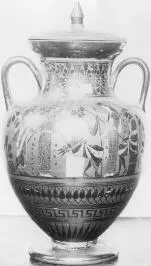
B, Herakles and Athena; Dionysos and Ariadne (or Semele?): all four seated, in pairs, and facing each other as if in conversation. Much is missing on this side.On the left, Herakles is seated to right on a camp-stool, with his right arm bent at the elbow. His himation is wrapped around his waist and covers his legs. In front of his right leg, part of his club is visible. Part of his head, with fillet, is preserved. Little remains of Athena: high-crested Attic helmet with fillet, point and butt of her spear, traces of her feet. Dionysos' ivy-wreathed head (to right) and his feet are preserved. In his raised hand, Dionysos holds a grape vine, which spreads above. Facing him, and seated to left, is a woman who holds out a flower in her raised right hand. Her head is wreathed, and she wears a himation over her chiton (lower drapery missing. Inscribed above the heads of the seated figures, “Kalias is beautiful”.
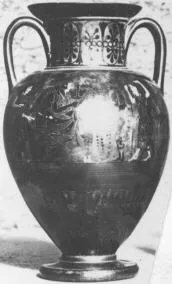
The amphora has an echinus mouth, reserved on the topside, with a red line on the inner and outer edge. The inside of the mouth and neck are glazed, with one red line at the junction of mouth and neck, and another about halfway down the neck (3.8 cm below the rim). The triple handles (A/B only preserved) are glazed on the outside, reserved on the inside. On the neck, a palmette-lotus chain with twisted links; a glaze line at the upper and lower limits of the pattern. Slight fillet or ring at junction of the neck and shoulder. On the shoulder, enclosed tongue pattern. Below each handle: configuration of 4 palmettes and 3 lotus buds, with tendrils crossed and a glaze dot in the center. Below the figures: one glaze line, then a group of three glaze lines, a band of alternately open and closed upright lotus buds, three glaze lines, leftward meander, and fifty-five rays. Fillet between body and foot. Torus foot, glazed on the top and halfway down the edge. One red line on the top-side of the foot, and another on the outer edge. Lower portion of foot edge and underside of foot reserved
After Clark, A., CVA Malibu 1 (1988).
B, Herakles and Athena; Dionysos and Ariadne (or Semele?): all four seated, in pairs, and facing each other as if in conversation. Much is missing on this side.On the left, Herakles is seated to right on a camp-stool, with his right arm bent at the elbow. His himation is wrapped around his waist and covers his legs. In front of his right leg, part of his club is visible. Part of his head, with fillet, is preserved. Little remains of Athena: high-crested Attic helmet with fillet, point and butt of her spear, traces of her feet. Dionysos' ivy-wreathed head (to right) and his feet are preserved. In his raised hand, Dionysos holds a grape vine, which spreads above. Facing him, and seated to left, is a woman who holds out a flower in her raised right hand. Her head is wreathed, and she wears a himation over her chiton (lower drapery missing. Inscribed above the heads of the seated figures, “Kalias is beautiful”.
The amphora has an echinus mouth, reserved on the topside, with a red line on the inner and outer edge. The inside of the mouth and neck are glazed, with one red line at the junction of mouth and neck, and another about halfway down the neck (3.8 cm below the rim). The triple handles (A/B only preserved) are glazed on the outside, reserved on the inside. On the neck, a palmette-lotus chain with twisted links; a glaze line at the upper and lower limits of the pattern. Slight fillet or ring at junction of the neck and shoulder. On the shoulder, enclosed tongue pattern. Below each handle: configuration of 4 palmettes and 3 lotus buds, with tendrils crossed and a glaze dot in the center. Below the figures: one glaze line, then a group of three glaze lines, a band of alternately open and closed upright lotus buds, three glaze lines, leftward meander, and fifty-five rays. Fillet between body and foot. Torus foot, glazed on the top and halfway down the edge. One red line on the top-side of the foot, and another on the outer edge. Lower portion of foot edge and underside of foot reserved
After Clark, A., CVA Malibu 1 (1988).

Images courtesy of The Metropolitan Museum of Art (CC0)