
Fragment of a krater
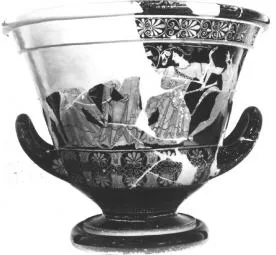
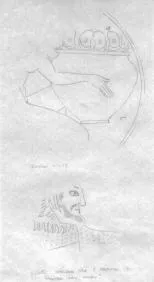
Callisto being turned into a bear. Her head, with ursine ears, and one clawed hand are visible to the right of a pollarded laurel tree. She is skillfully drawn in three-quarter view, with attention to such details as pupils, irises, eyelashes, and the hairs on the nape. Her long locks are rendered with a multitude of relief lines. The spotted cloak of another figure (Artemis?) appears to the left, possibly a shoulder and forearm. ITALIAN VASE PAINTING in ITALY, # 12 (13.206) Fragment of a Krater Attributed to the Black Fury Painter 390-380 B.C. Callisto being turned into a bear. Her head, with ursine ears, and one clawed hand are visible to the right of a pollarded laurel tree. She is skillfully drawn in three-quarter view, with attention to such details as pupils, irises, eyelashes, and the hairs on the nape. Her long locks are rendered with a multitude of relief lines. The spotted cloak of another figure (Artemis?) appears at the left, possibly a shoulder and forearm. This piece well illustrates the early stages of the Ornate syle, and the quality of the drawing supports Trendall's comment that "Fragments... from vases in the Black Fury Group must rank among the finest examples of early Apulian vase-painting" (Handbook, p. 78). An oinochoe in the Getty Museum (72, AE.128) presents the subject in fuller form; see A.D. Trendall, AntK 20 (1977), pp. 99-101; RVAp, I, pp. 165-167, no. 7/12. For Callisto, see I. McPhee, LIMC, V, 1, pp. 940-944; V, 2, pls. 604-605.

Images courtesy of The Metropolitan Museum of Art (CC0)