
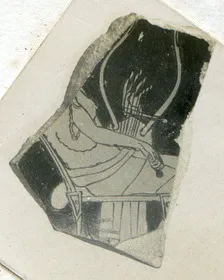
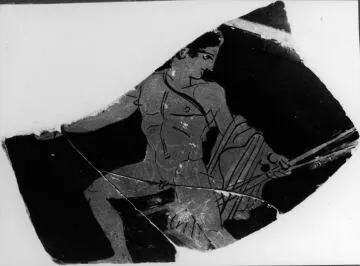
Drinking cup (kylix) with seated woman with phiale
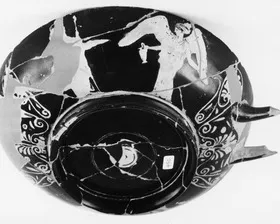
Interior, a woman seated to left on series of white and orange cushions, a phiale in raised right hand, left hand extended behind her holding a scroll; she wears girded Doric chiton, slippers, decorated headdress, necklace and bracelets; before her a scroll ornament; near the edge an ivy leaf band with rows of white dots; Exterior, ivy leaf band near the edge.. Low bowl without stem, angular handles. Clay red, with fine bits of mica, and occasional pieces of chalk. Inside a circle with six small radial palmettes impressed. White, orange, and violet red applied. ITALIAN VASE PAINTING in ITALY, #104 (19.309) Kylix Attributed to the Aphrodite Painter 340-330 B.C. Interior: A woman is seated tothe left on an irregular pile of white rocks with yellow shadow bands. She holds a phiale in her raised right hand and a sprig of ivy in her left, its added color now effaced. She wears a chiton, kekryphalos, shoes, bracelets, earrings, and a necklace; the jewelry is white and the shoes have white spots. The white dots in her lap may be offerings to place in the phiale. There is a rosette above and a scrolling palmette at the left, both with touches of added white. The groundline is a row of white dots. A wreath of laurel with white berries circles the i nner rim. In the very center of the interior, concealed by the painting, is a stamped desigh: a circle surrounded by palmettes. Exterior: There is a wreath of laurel between the handles on both sides. This unusual combination of techniques - painting over a stamped design - occurs on a cup of similar shape, also by the Aphrodite Painter (RVP, p. 250. no. 2/984, pl. 155d). The Boston cup was originally thought to be Apulian, but a fuller knowledge of the Aphrodite Painter's work has led Trendall to assign it to his hand. The painter was obviously aware of contemporary Apulian vase-painting whence he may have borrowed the white rock drawn in the Apulian manner; see RVP, p. 250.
Images courtesy of The Metropolitan Museum of Art (CC0)