
Drinking cup (kylix)
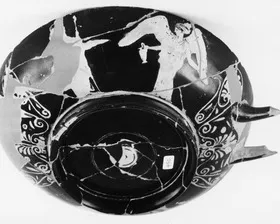
Interior: Seated bearded figure looking towards an altar on which sits a cock. Exterior: A and B have the same scene: Youth with head in profile to left looks at a woman who looks to left. Repaired with restorations which destroyed the heads of A and B. VASE PAINTING in ITALY, #165 (01.8114) Kylix Faliscan about 380-360 B.C. Interior: A wreathed and bearded man wearing a himation with a wave-pattern border is seated to the right. His scepter, with lotus finial, held vertically in his left hand, identifies him as a king, perhaps Zeus himself. He looks toward an altar with Ionic volutes and moldings of eggs and wave-pattern, on which stands a cock. Also on the altar is an egg or, more probably, a pomegranate in added color. In the field before the altar is an elaborate rosette or phiale. A and B: On either side, a nude young athlete stands in conversation with a woman clad in a belted chiton, both gesturing with their hands. There is a large palmette under each handle. Flanking the handles and framing the figures are large palmettes enclosed by tendrils liked to the palmettes beneath the handles. The exterior groundline consists of two stripes. The circular frame of the tondo consists of groups of stopt maeanders to right alternating with saltire-squares. The bottom of the foot is reserved except for broad stripes around the center and the outer edge (the resting surface) and a slender stripe just within the outer edge. If it is Zeus who is represented in the cups interior, the association with a cock is unusual, though not unprecedented. The cock is the sacred bird of the youthful Zeus Felchanos of Phaistos (A.B. Cook," Zeus: A Study in Ancient Religion, II," 2[Cambridge, 1925], pp. 946-947, figs. 838-841; III, 2[Cambridge, 1940] p. 1042, note 9). Beazley interpreted the figure as Zeus with the cock of Ganymede. It seems more likely,however,that Hades rather than Zeus is intended. On Locrian pinakes, Hades and Persephone are frequently shown together with roosters and pomegranates. Although Hades occasionally holds the pomegranate, the rooster is usually held by Persephone (R. Lindner in LIMC, IV, 1, pp.375-379 [nos. 49-61], 391-392; IV, 2, pl. 213). The objects on the altar would thus allude to Persephone. The association between the cock, the pomegranate, and the altar seems more appropriate for a major divinity like Persephone than a minor demigod like Ganymede. How influence passed from the rather geographically limited and specific cult at Locri to Etruria, however, is not immediately apparent. Stylistically, the painter of this kylix looked to Athens rather than to South Italy.


Images courtesy of The Metropolitan Museum of Art (CC0)