
Attic Red-Figure Volute Krater
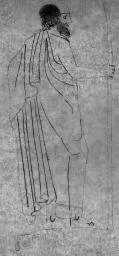
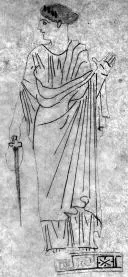
Fragments preserving most of the rim and neck, as well as a small section of the upper body. Neck. A.–B. A thiasos with six satyrs and five maenads runs around the neck interrupted by the handles. On A, three pairs of satyrs and maenads. The maenad on the left is dressed in a chiton and himation, and moves to left looking back at a satyr. A feline is perched on her extended left arm and hand. The nude satyr who pursues her carries a full wineskin over his shoulder and a forked stick in his right hand. Behind him, a maenad dressed in a belted peplos chases a satyr to the right. She holds a forked stick horizontally in her right hand, and a leopard skin is draped over her extended left arm and pinned at her right shoulder. Before her a nude satyr, in three- quarter back view, looks back while moving to the right holding out a wineskin in his right hand. A fillet hangs above in the background. The third pair consists of a maenad, dressed in a belted peplos, who moves to the right toward a satyr who bends over to right with a leopard skin draped across his back. A kantharos hangs suspended in the field above him. The maenad has tear-drop earrings and swings a thyrsos at the satyr who scampers off on all fours. Like her counterpart in the central pair, she has a leopard skin draped over her extended left arm. Each maenad has her hair tied up in a krobylos. There are no real framing figures on this side, giving the impression that the scene continues on side B, which shows three satyrs with two maenads between them. Two satyrs at the two ends may serve as framing figures indicating the ends of the scene. On the left, a nude satyr (face missing) moves to the right with a torch in his left hand facing right. A maenad before him runs to the right wearing a chiton and carrying a thyrsos(?) (upper end not preserved) over her left shoulder. She has thrown her head back in song or ecstasy. The satyr in the middle, facing left, approaches a pointed amphora lying before him. Behind him another maenad runs to left, looking back at the satyr who pursues her. She is dressed in a peplos and carries a lighted torch in each hand. Her hair is tied up in a krobylos and is decorated with a diadem. At the right end of the scene stands a thyrsos with a kantharos suspended above it.
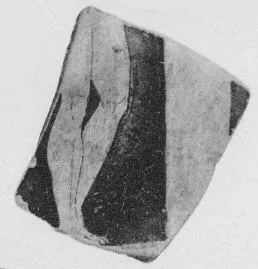
Body. A. Ilioupersis. Ajax and Kassandra. Only the upper parts of the figures are preserved. The Palladion, dressed in a peplos and armed with an Attic helmet, spear, and a shield, stands frontally in the center of the scene. Athena (only her head is preserved) stands to the right of the statue facing left and wearing an Attic helmet. An inscription indicates Menalos appeared further to the right. On the other side of the Palladion, Kassandra (only her head is preserved), wearing a dotted band with three upright leaves around her head, sits or kneels at the feet of the statue. Ajax (upper part of his body and head are preserved but his face is missing) reaches for Kassandra with his right hand. He is bearded, wears a low-crested Corinthian helmet pushed back on his head, and has a himation slung over his right shoulder. The round shield on his left arm is shown in a three-quarter view from the inside, and is decorated with a four-pointed star. Behind him on the left, a female attendant or priestess (upper part of the body and head preserved) stands to the right. Dressed in a chiton and wearing a disk earring, she has her hair tied up in a krobylos and carries on her head a chest decorated with a red rosette and tendrils.
Flaring rim flat and black on the top. Offset at the top of figured frieze and another at the top of the lotus and palmette frieze; a groove at the junction of the neck with the body. Interior black to the base of the neck with a reserved band under the shoulder and thinner, irregular black inside the body. Ionic kymation on the outside edge of rim. Convex zone below it with ivy and berry pattern. Narrow flat zone with Ionic kymation between the rim and the neck. Upper zone of neck decorated with alternating budding lotuses and encircled palmettes. Black tongue pattern beneath the junction of neck with the body; all the patterns are interrupted at the handles. Traces of an inverted palmette beneath the one preserved stump of a handle.
Body. A. Ilioupersis. Ajax and Kassandra. Only the upper parts of the figures are preserved. The Palladion, dressed in a peplos and armed with an Attic helmet, spear, and a shield, stands frontally in the center of the scene. Athena (only her head is preserved) stands to the right of the statue facing left and wearing an Attic helmet. An inscription indicates Menalos appeared further to the right. On the other side of the Palladion, Kassandra (only her head is preserved), wearing a dotted band with three upright leaves around her head, sits or kneels at the feet of the statue. Ajax (upper part of his body and head are preserved but his face is missing) reaches for Kassandra with his right hand. He is bearded, wears a low-crested Corinthian helmet pushed back on his head, and has a himation slung over his right shoulder. The round shield on his left arm is shown in a three-quarter view from the inside, and is decorated with a four-pointed star. Behind him on the left, a female attendant or priestess (upper part of the body and head preserved) stands to the right. Dressed in a chiton and wearing a disk earring, she has her hair tied up in a krobylos and carries on her head a chest decorated with a red rosette and tendrils.
Flaring rim flat and black on the top. Offset at the top of figured frieze and another at the top of the lotus and palmette frieze; a groove at the junction of the neck with the body. Interior black to the base of the neck with a reserved band under the shoulder and thinner, irregular black inside the body. Ionic kymation on the outside edge of rim. Convex zone below it with ivy and berry pattern. Narrow flat zone with Ionic kymation between the rim and the neck. Upper zone of neck decorated with alternating budding lotuses and encircled palmettes. Black tongue pattern beneath the junction of neck with the body; all the patterns are interrupted at the handles. Traces of an inverted palmette beneath the one preserved stump of a handle.
Images courtesy of The Metropolitan Museum of Art (CC0)