
Attic Black-figure "Tyrrhenian" Amphora with (A) a Wedding Procession and (B) a Combat Scene
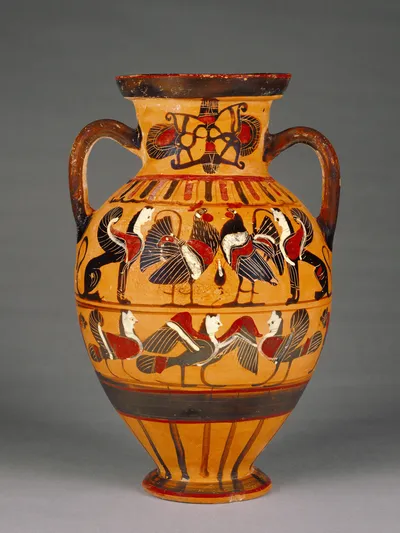
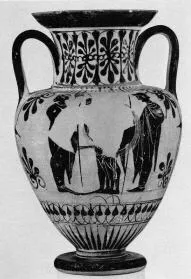
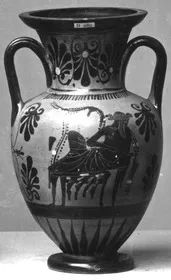
The Tyrrhenian-style neck amphora has a typically tall, ovoid body; a short neck with a raised fillet at the join of the shoulder; and an inverted echinus foot. The scene on side A depicts a wedding procession of the gods. At right, Hermes is at the head of the procession. He wears a short white tunic, red chlamys, winged boots, and holds a caduceus. He looks back at two goddesses, one of whom stands with hands raised in front of a black and a white horse pulling a biga (chariot). Behind the pair of horses, a second goddess holds up wreaths and torches. The goddesses greet the bridal couple, a bearded man and a woman holding her veil before her face, who stand in the biga. Behind them is Dionysos, who wears a crown of white ivy leaves and a long red mantle. Dionysos looks back at two goddesses at the rear of the procession, the first of whom carries a wreath. Between the figures are vertical nonsense inscriptions in the field.
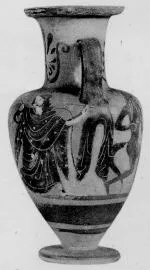
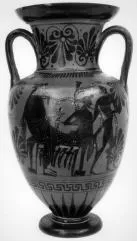
Side B shows two warriors in single combat, each holding a shield in front of them and brandishing spears. Behind the nude warrior on the right, who is armed with a Corinthian crested helmet and greaves, is a woman holding a wreath, and old man with white beard and hair, and another woman. Following the warrior at left, wearing a Corinthian crested helmet, white tunic, and greaves, is a similar threesome: a woman who raised both hands toward the combatants, an elderly man holding a spear, who raises one hand to his forehead in alarm; and another woman. There are nonsense inscriptions in the field.
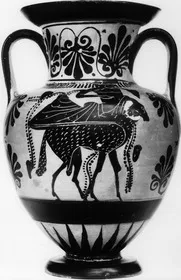
The outer edge of the rim is decorated with intertwining lotus buds. On the neck is a frieze of addorsed lotus-palmettes, below which is a thick black band. The top of the shoulder has alternating black and red tongues. Below the figural frieze on the shoulder, from top to bottom, are three thin bands, a thick black band, three thin bands, alternating black and red tongues, an addorsed lotus-palmette frieze, alternating black and red tongues, a pair of thin bands, a broad black band, intertwining lotus blossoms and buds, a black band, and rays around the base. The top of the foot is black with two red lines at the outer edge. Substantial areas of the black glazed handles, bands, and foot are misfired red. Added red is used for the figures’ drapery, the chest of the black horse, and on the subsidiary ornament; added white for female flesh, a horse, and the drapery of the groom and Hermes.
This type of ovoid amphora with densely patterned friezes is known as "Tyrrhenian," a term derived from the Greek word for Etruscans, "Tyrsenoi." Some two hundred amphorae of this shape and bold style were produced during the second quarter of the sixth century B.C. in an Athenian workshop for export overseas, and most have been found in Etruria. A majority come from the cemeteries of Vulci and Cerveteri.
Side B shows two warriors in single combat, each holding a shield in front of them and brandishing spears. Behind the nude warrior on the right, who is armed with a Corinthian crested helmet and greaves, is a woman holding a wreath, and old man with white beard and hair, and another woman. Following the warrior at left, wearing a Corinthian crested helmet, white tunic, and greaves, is a similar threesome: a woman who raised both hands toward the combatants, an elderly man holding a spear, who raises one hand to his forehead in alarm; and another woman. There are nonsense inscriptions in the field.
The outer edge of the rim is decorated with intertwining lotus buds. On the neck is a frieze of addorsed lotus-palmettes, below which is a thick black band. The top of the shoulder has alternating black and red tongues. Below the figural frieze on the shoulder, from top to bottom, are three thin bands, a thick black band, three thin bands, alternating black and red tongues, an addorsed lotus-palmette frieze, alternating black and red tongues, a pair of thin bands, a broad black band, intertwining lotus blossoms and buds, a black band, and rays around the base. The top of the foot is black with two red lines at the outer edge. Substantial areas of the black glazed handles, bands, and foot are misfired red. Added red is used for the figures’ drapery, the chest of the black horse, and on the subsidiary ornament; added white for female flesh, a horse, and the drapery of the groom and Hermes.
This type of ovoid amphora with densely patterned friezes is known as "Tyrrhenian," a term derived from the Greek word for Etruscans, "Tyrsenoi." Some two hundred amphorae of this shape and bold style were produced during the second quarter of the sixth century B.C. in an Athenian workshop for export overseas, and most have been found in Etruria. A majority come from the cemeteries of Vulci and Cerveteri.
Images courtesy of The Metropolitan Museum of Art (CC0)