
The Minotaur, a monster with a bull's head and a human body, was the child of the Cretan queen and a bull for which she had developed an irresistible passion. The Minotaur lived in a labyrinth on Crete and devoured human sacrifices of youths and maidens sent as tribute from Athens. When the Greek hero Theseus finally killed the monster, he freed Athens from this horrible burden.
The myth of Theseus and the Minotaur was very popular on Athenian vases in the late 500s B.C. In this rendition, Theseus plunges his sword through the monster's neck, while the freed youths and maidens watch. The Minotaur's uncivilized nature is apparent even in its choice of weapon - a rock, seen clutched in its raised hand.
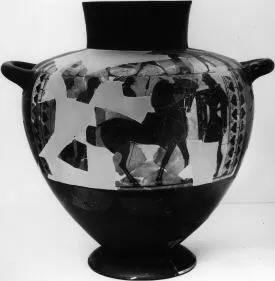
The back of the vase shows two youths mounted on horses, greeted by family members as they return home. Scenes of returning youths and warriors were frequent in Athenian vase-painting. The youths may be mythological figures such as the Dioskouroi, or they may simply be mortals.
The myth of Theseus and the Minotaur was very popular on Athenian vases in the late 500s B.C. In this rendition, Theseus plunges his sword through the monster's neck, while the freed youths and maidens watch. The Minotaur's uncivilized nature is apparent even in its choice of weapon - a rock, seen clutched in its raised hand.
The back of the vase shows two youths mounted on horses, greeted by family members as they return home. Scenes of returning youths and warriors were frequent in Athenian vase-painting. The youths may be mythological figures such as the Dioskouroi, or they may simply be mortals.
Images courtesy of The Metropolitan Museum of Art (CC0)