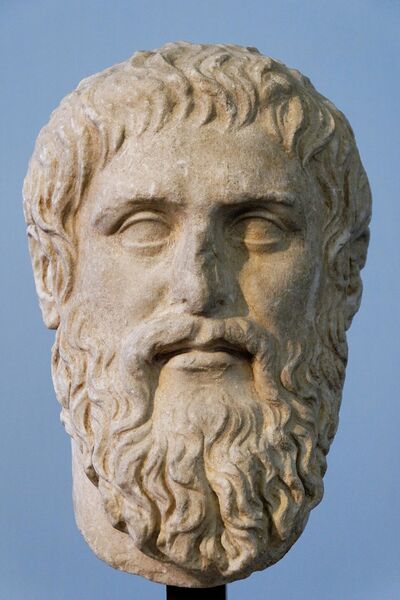
Plato
Plato
The founder of Western philosophy
c. 428 BC – 348 BC
Plato was born around 428 BC into one of the most distinguished families in Athens — his mother's family traced their lineage to Solon, and his relatives included Critias and Charmides, both members of the Thirty Tyrants. He might have pursued a career in politics, but two events changed his course: the tyranny of the Thirty, which disgusted him, and the execution of Socrates in 399 BC, which appalled him.
Instead, he wrote. The dialogues — over thirty survive, most probably genuine — are the foundation documents of Western philosophy. They are also works of extraordinary literary art: dramatic, witty, moving, and endlessly fertile. In them, Socrates interrogates his fellow Athenians about justice, knowledge, beauty, love, the good life, and the nature of reality. The early dialogues (the Apology, the Euthyphro, the Crito) present a Socrates recognisably close to the historical figure. The middle dialogues (the Republic, the Phaedo, the Symposium, the Phaedrus) develop Plato's own theory of Forms — the doctrine that the visible world is a shadow of a higher, intelligible reality. The late dialogues (the Timaeus, the Laws, the Sophist) grow increasingly technical.
Around 387 BC he founded the Academy, the first institution of higher learning in the Western world, which survived for over nine hundred years. His most famous pupil was Aristotle.
Plato's influence on Western thought is incalculable. Whitehead's remark that all of Western philosophy is a series of footnotes to Plato is an exaggeration, but not a wild one. His theory of Forms, his political philosophy, his psychology, his aesthetics, and his epistemology have shaped every subsequent generation of thinkers.
Works (36)
-
1
Alcibiades 1 philosophy
Alcibiades confronts Socrates about his feelings for him. What begins as a conversation about love becomes a devastating examination of self-knowledge...
-
2
Alcibiades 2 philosophy
A spurious dialogue on whether tyranny or democracy is preferable. Attributed to Plato but almost certainly by a later imitator.
-
3
Apology philosophy
The trial of Socrates. He has been charged with impiety and corrupting the youth. His defence is not really a defence — it is an explanation of why he...
-
4
Charmides philosophy
A dialogue on self-restraint and self-knowledge, set in a gymnasium. Socrates examines what it means to know yourself and whether temperance can be de...
-
5
Cleitophon philosophy
Cleitophon reproaches Socrates for inspiring people to pursue virtue but never explaining what virtue actually is. The shortest Platonic dialogue — an...
-
6
Cratylus philosophy
A dialogue on the names of things. Do words have a natural connection to what they describe, or is language purely conventional? Socrates examines doz...
-
7
Critias philosophy
The unfinished sequel to Timaeus. Critias describes the ancient war between Athens and Atlantis. The dialogue breaks off mid-sentence — the story of A...
-
8
Crito philosophy
Socrates is in prison, awaiting execution. His friend Crito offers to arrange an escape. Socrates refuses, arguing that he is bound by the laws of Ath...
-
9
Epinomis philosophy
An appendix to the Laws, attributed to Plato's student Philip of Opus. It discusses the role of astronomy and mathematics in the education of the guar...
-
10
Euthydemus philosophy
Socrates debates two Sophist brothers who use logical tricks to refute any statement whatsoever. The dialogue is Plato's most sustained attack on eris...
-
11
Euthyphro philosophy
Socrates is about to be tried for impiety. Outside the court, he meets Euthyphro, who claims to know what piety is. Socrates asks. Five definitions la...
-
12
Gorgias philosophy
Gorgias is the most famous rhetorician in the Greek world. Socrates asks him what rhetoric actually is. The conversation escalates from polite inquiry...
-
13
Greater Hippias philosophy
Socrates discusses whether the two Hippiases — both named after the Sophist Hippias — are really the same. A short, playful dialogue about the unity o...
-
14
Hipparchus philosophy
A short dialogue attributed to Plato about the tyrant Hipparchus, who was assassinated in Athens. Probably spurious, but explores the nature of love o...
- 15
-
16
Laches philosophy
Can courage be taught? Socrates discusses virtue with two Athenian generals who cannot define the courage they display in battle.
-
17
Laws philosophy
Plato's longest and last work. An Athenian stranger discusses legislation for a new colony in Crete, covering everything from marriage law to drinking...
-
18
Lesser Hippias philosophy
Hippias claims he can answer any question. Socrates asks whether it is possible to do wrong voluntarily. The argument leads to the paradox that the pe...
-
19
Letters philosophy
A collection of letters attributed to Plato. The Seventh Letter, if genuine, is the closest thing to an autobiography Plato wrote — his disillusionmen...
-
20
Lovers philosophy
A short dialogue in which Socrates encounters two young men in a gymnasium and asks them what they love. Probably spurious.
-
21
Lysis philosophy
Is friendship based on likeness or difference? Socrates examines the nature of love between friends and finds that none of the obvious answers survive...
-
22
Menexenus philosophy
A funeral oration attributed to Socrates, parodying the conventions of Athenian public oratory. Whether sincere or satirical, it reads as Plato's medi...
-
23
Meno philosophy
Can virtue be taught? Meno asks Socrates, who responds by demonstrating that an uneducated slave can be led to discover a geometric proof. Knowledge i...
-
24
Minos philosophy
A dialogue on what Minos the legendary king has to do with law. Probably spurious, but included in the ancient corpus as a preface to the Laws.
-
25
Parmenides philosophy
Parmenides — the greatest philosopher of the previous generation — meets the young Socrates and demolishes the Theory of Forms. The second half is a d...
-
26
Phaedo philosophy
Socrates' last day. He discusses the immortality of the soul with his friends, then drinks the hemlock. The most moving death scene in Western philoso...
-
27
Phaedrus philosophy
Phaedrus reads Socrates a speech about love. Socrates responds with two of his own — the second a soaring myth about the soul as a charioteer driving...
-
28
Philebus philosophy
What is pleasure, and how does it relate to the good life? Socrates argues that neither pure pleasure nor pure knowledge is sufficient — the good life...
-
29
Protagoras philosophy
Socrates takes on the great Sophist Protagoras in a debate about whether virtue can be taught. The argument is playful, competitive, and ends with bot...
-
30
Republic philosophy
What is justice? Socrates constructs an ideal city to answer the question, then maps the city's structure onto the individual soul. Ten books covering...
-
31
Sophist philosophy
A stranger from Elea hunts for the definition of "sophist" using the method of division. What begins as a logical exercise becomes an investigation in...
-
32
Statesman philosophy
The companion piece to the Sophist. The Eleatic Stranger defines the statesman by the same method of division, then asks what makes a good ruler. Plat...
-
33
Symposium philosophy
A drinking party where each guest gives a speech in praise of love. Socrates reports what the priestess Diotima taught him about desire. Then Alcibiad...
-
34
Theaetetus philosophy
The nature of knowledge itself. Socrates and the young mathematician Theaetetus try three definitions — perception, true belief, true belief with an a...
-
35
Theages philosophy
A short dialogue about the relationship between Socrates and a young man named Theages who wants to study with him. The question of Socrates' "divine...
-
36
Timaeus philosophy
Timaeus describes the creation of the universe — how a divine craftsman shaped the cosmos from mathematical principles. The most influential cosmologi...