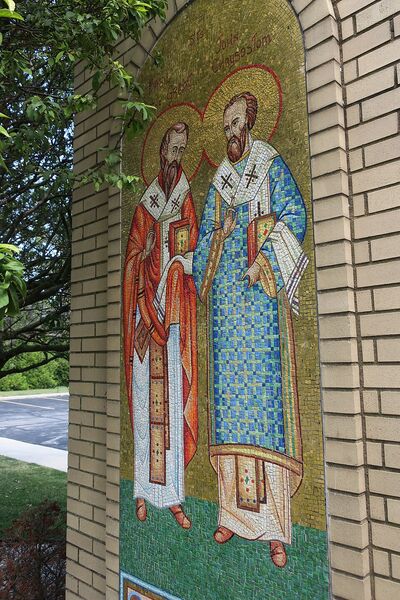
Basilius Caesariensis
Basil
The great Cappadocian father
AD 330 – AD 379
Basil of Caesarea, known as Basil the Great, was born around 329 AD into one of the most remarkable families in Christian history. His grandmother Macrina the Elder, his mother Emmelia, his sister Macrina the Younger, and his brothers Gregory of Nyssa and Peter of Sebaste are all venerated as saints. The family was wealthy, cultured, and deeply devout.
Basil studied in Constantinople and Athens, where his classmate and lifelong friend was Gregory of Nazianzus. After completing his education he toured the monastic communities of Egypt, Palestine, and Mesopotamia before founding his own monastic community in Pontus. His Rule, emphasising communal life, manual labour, and liturgical prayer, became the foundation of Eastern monasticism and remains the basis of monastic life in the Orthodox churches.
As Bishop of Caesarea from 370 until his death in 379, Basil was one of the principal architects of Nicene orthodoxy against Arianism. His theological writings, vast correspondence (over 300 letters survive), and institutional reforms — including the creation of the Basileias, a vast charitable complex for the poor and sick — made him one of the most influential figures of the fourth century. De legendis gentilium libris (To Young Men, on How They Might Derive Benefit from Greek Literature) is a graceful defence of classical learning for Christian students that shaped attitudes toward pagan literature for centuries.
Works (2)
-
1
De legendis gentilium libris prose
Basil advises young Christians on how to read pagan literature — take what is useful, leave what is harmful. The key text in the survival of classical...
- 2